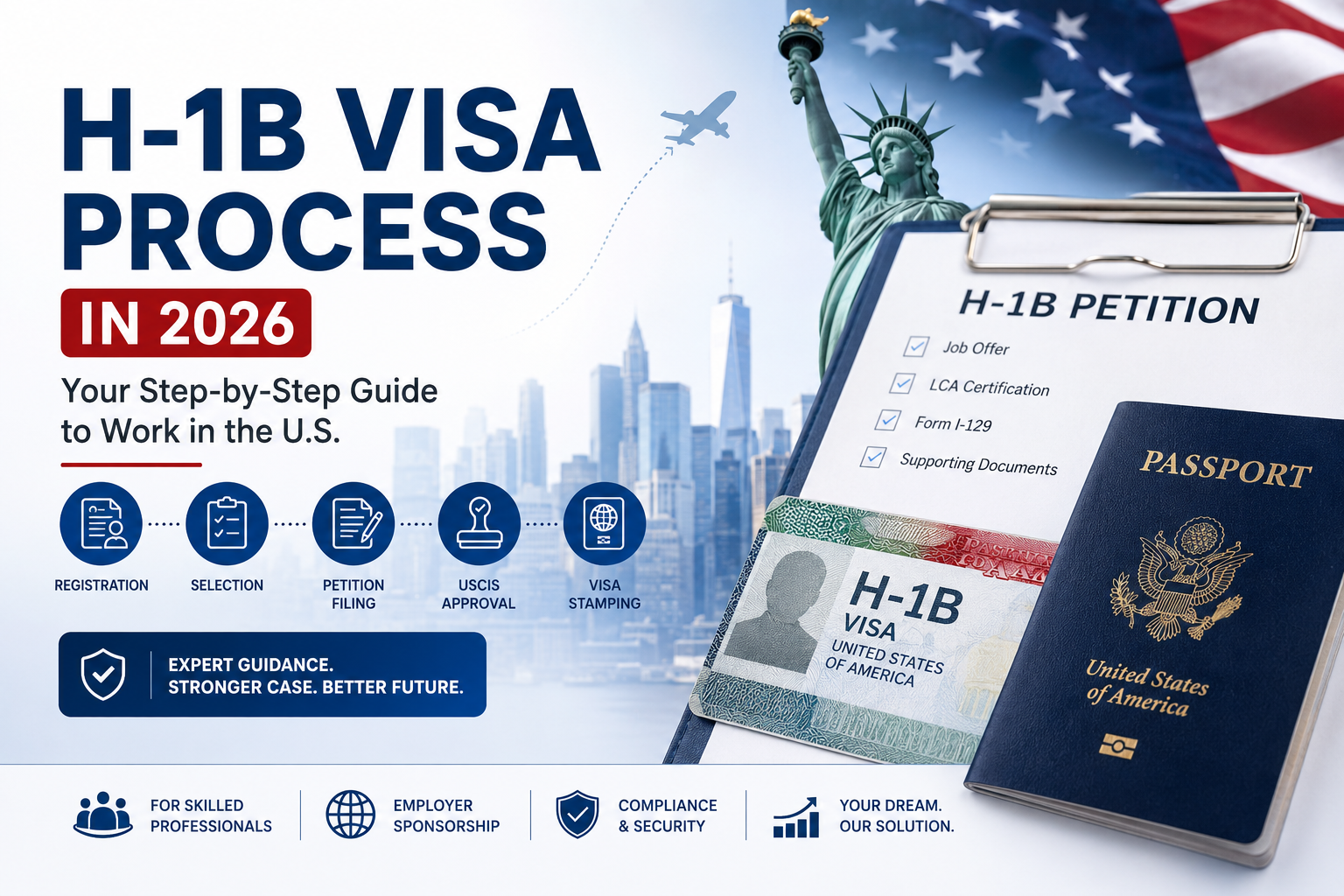
The H-1B visa process in 2026 has become more complex than in previous years.
Applicants and employers now need to understand not only the traditional H-1B requirements, registration process, Labor Condition Application (LCA), petition filing, and visa interview, but also significant changes to H-1B selection and entry requirements.
For FY 2027, USCIS introduced a wage-weighted H-1B selection process that gives greater selection weight to higher-paid positions. In addition, a September 2025 presidential proclamation created a $100,000 payment requirement for certain new H-1B petitions involving beneficiaries outside the United States, subject to the proclamation’s terms and exceptions.
For professionals planning to work in the United States, understanding the process before taking action is more important than ever.
This guide explains the H-1B visa process in 2026, including eligibility, registration, selection, petition filing, visa stamping, change of status, common problems, and how professional immigration assistance can help.
What Is an H-1B Visa?
The H-1B visa is a U.S. nonimmigrant work classification for foreign professionals who will work in a qualifying specialty occupation.
Specialty occupations generally require the theoretical and practical application of specialized knowledge and normally require at least a bachelor’s degree or equivalent in a specific specialty.
H-1B positions commonly include fields such as:
- Software development
- Information technology
- Engineering
- Data science
- Architecture
- Accounting
- Healthcare
- Research
- Business specialties
- Other qualifying professional occupations
The employer generally plays the central role in the H-1B petition process.
How Does the H-1B Process Work in 2026?
The process can be summarized as:
Job Offer → Eligibility Review → LCA → H-1B Registration → Selection → Form I-129 → USCIS Decision → Visa/Status Process → Employment
However, the exact steps depend on whether the applicant is:
- Outside the United States
- Already in the United States
- Changing from another status
- Extending an existing H-1B
- Transferring to another employer
- Subject to the annual H-1B cap
- Eligible for a cap-exempt H-1B
Step 1: Find a Qualifying U.S. Employer
The H-1B process normally begins with a U.S. employer willing to sponsor the applicant.
The employer must have a qualifying position and demonstrate that the offered employment meets the applicable H-1B requirements.
The job should generally involve specialized duties that qualify as a specialty occupation.
This means the job title alone is not enough.
The actual job duties, degree requirements, employer practices, and supporting documentation matter.
Step 2: Determine H-1B Eligibility
Before registration or petition filing, the employer and applicant should evaluate eligibility.
Important factors can include:
Education
The applicant generally needs a U.S. bachelor’s degree or higher in the required specialty, a foreign degree equivalent to the required U.S. degree, or another qualifying basis under the applicable rules.
Specialty Occupation
The position must qualify as a specialty occupation under the H-1B regulations.
Employer-Employee Relationship
The employer must establish the required relationship and demonstrate that it has a legitimate qualifying position for the beneficiary.
Work Location
The employment location can affect the Labor Condition Application and wage analysis.
Wage Requirements
The employer must comply with applicable wage requirements and labor-condition obligations.
Step 3: Determine Whether the H-1B Is Cap-Subject
Not every H-1B petition goes through the annual registration selection process.
The standard annual H-1B cap includes:
- 65,000 regular H-1B numbers
- 20,000 additional numbers for qualifying U.S. advanced-degree beneficiaries
Certain employers and circumstances can qualify for cap-exempt treatment.
For example, certain institutions of higher education and qualifying nonprofit or research organizations may fall under cap-exempt provisions.
Therefore, determining whether a case is cap-subject or cap-exempt is an important early step.
Step 4: H-1B Electronic Registration
For cap-subject cases, prospective petitioners generally need to register the beneficiary electronically during the designated registration period.
For FY 2027, USCIS announced that registration ran from:
March 4, 2026 → March 19, 2026
The registration fee was $215 per beneficiary. USCIS stated that selection notifications were expected by March 31, 2026.
As of August 2026, that registration window has already closed.
Applicants who were not registered during the applicable window generally cannot simply submit a new cap-subject registration outside the announced period.
Step 5: Understand the New H-1B Weighted Selection Process
One of the biggest changes to the H-1B process in 2026 is the new weighted selection system.
Beginning with FY 2027, USCIS moved away from the previous purely random selection approach for oversubscribed cap registrations.
Under the new system, registrations are weighted according to the applicable wage level.
The structure provides:
- Wage Level I: 1 selection entry
- Wage Level II: 2 selection entries
- Wage Level III: 3 selection entries
- Wage Level IV: 4 selection entries
The purpose is to give higher-paid and higher-skilled positions greater weight while retaining opportunities across wage levels.
Does a Higher Salary Guarantee H-1B Selection?
No.
A higher wage level can provide greater selection weight under the new system, but it does not guarantee selection.
Employers should provide accurate information about the offered position, occupation, and wage level.
Applicants should also understand that employers cannot simply manipulate wage information to create an artificial advantage.
Step 6: Selection Notification
If the registration is selected, the employer can generally proceed with filing the cap-subject H-1B petition during the filing period specified by USCIS.
Selection is not the same as H-1B approval.
This is an important distinction.
The process is:
Registration → Selection → Petition → USCIS Adjudication → Approval
Being selected means the employer has an opportunity to file the petition. USCIS must still determine whether the petition satisfies the applicable requirements.
Step 7: Labor Condition Application
Before filing the H-1B petition, the employer generally must obtain a certified Labor Condition Application (LCA) from the U.S. Department of Labor.
The LCA contains information relating to the employment, including:
- Job position
- Wage
- Employment location
- Period of employment
The employer makes required attestations concerning wages and working conditions.
The LCA is an important part of the H-1B process because the government uses it to ensure that applicable labor protections are addressed.
Step 8: File Form I-129
After selection and preparation of the required documentation, the employer files the H-1B petition using Form I-129, Petition for a Nonimmigrant Worker.
The petition package can include evidence such as:
- Employer information
- Job offer
- Detailed job description
- LCA
- Beneficiary’s educational credentials
- Degree documents
- Experience letters
- Resume
- Status documents
- Supporting company documents
- Evidence establishing the specialty occupation
The exact documentation depends on the circumstances of the case.
Step 9: USCIS Reviews the Petition
USCIS reviews the petition to determine whether the employer and beneficiary qualify for the requested H-1B classification.
USCIS may:
- Approve the petition
- Request additional evidence
- Deny the petition
If USCIS issues a Request for Evidence (RFE), the employer must respond within the applicable deadline.
An RFE does not automatically mean the case will be denied.
However, the response needs to directly address the issues identified by USCIS and provide appropriate supporting evidence.
Step 10: H-1B Change of Status or Consular Processing
After petition approval, the next step depends on where the applicant is located and the requested immigration procedure.
Change of Status
An eligible applicant already in the United States may request a change of status through the H-1B petition.
For example, an eligible F-1 student may potentially change from F-1 status to H-1B status if the requirements are met.
Consular Processing
An applicant outside the United States generally needs to apply for an H-1B visa through a U.S. embassy or consulate after petition approval.
The Department of State notes that petition-based temporary worker applicants should complete the DS-160 and follow the instructions of the embassy or consulate where they apply.
Step 11: Complete Form DS-160
For applicants who need an H-1B visa abroad, the DS-160 Online Nonimmigrant Visa Application is a key step.
Applicants should provide accurate information about:
- Personal details
- Passport
- Education
- Employment
- Travel history
- U.S. employment
- Previous U.S. immigration history
The Department of State advises applicants to answer the DS-160 accurately and completely.
For H-1B applicants, having a copy of the approved petition and relevant petition information available can be important when completing the application.
Step 12: Schedule the Visa Interview
Applicants applying for an H-1B visa outside the United States generally need to follow the interview and appointment procedures of the applicable U.S. embassy or consulate.
In July 2026, the Department of State updated its guidance stating that nonimmigrant visa applicants should generally schedule interviews in their country of nationality or residence, subject to designated-post rules and exceptions.
Because appointment procedures can vary, applicants should review the current instructions for the location where they intend to apply.
Step 13: Attend the H-1B Visa Interview
During the visa interview, the consular officer may ask questions about:
- Your employer
- Your job
- Your educational background
- Your experience
- Your work location
- Your previous U.S. immigration history
- Your intended employment
Applicants should answer honestly and consistently with the information contained in their petition and DS-160.
Step 14: Visa Issuance and U.S. Entry
If the visa application is approved, the applicant can receive the H-1B visa according to the applicable procedures.
However, a visa does not automatically guarantee admission to the United States.
Admission is determined by U.S. Customs and Border Protection at the port of entry.
Important 2026 H-1B $100,000 Payment Requirement
One of the most important changes applicants and employers need to understand in 2026 is the September 2025 presidential proclamation concerning certain new H-1B petitions.
The proclamation restricts entry for certain H-1B workers outside the United States unless the applicable petition is accompanied or supplemented by a $100,000 payment, subject to its terms and exceptions.
USCIS guidance states that the measure applies prospectively to certain petitions filed after September 21, 2025, and does not apply to certain previously filed petitions, currently approved petitions, or individuals holding validly issued H-1B visas.
This is an area where case-specific legal analysis is especially important.
Applicants should not assume that every H-1B case requires the $100,000 payment.
The applicability depends on factors including the petition, filing circumstances, and whether the beneficiary is inside or outside the United States.
H-1B Visa Process for Applicants Already in the U.S.
The process can be different for applicants who are already legally present in the United States.
Depending on the circumstances, an applicant may be seeking:
- Change of status
- H-1B extension
- H-1B transfer
- Amendment
- Concurrent H-1B employment
These cases do not necessarily follow the same process as a new applicant applying for an H-1B visa abroad.
For example, an H-1B worker changing employers may have a different petition strategy from an international student seeking initial H-1B status.
H-1B Transfer in 2026
An H-1B transfer generally involves a new employer filing a petition for an H-1B worker who already holds H-1B status.
Unlike a first-time cap-subject H-1B, a qualifying H-1B worker who has already been counted against the cap may generally change employers without going through the annual cap registration again.
However, the specific circumstances matter.
Applicants should carefully review:
- Current H-1B status
- I-94 validity
- Previous approvals
- New employment terms
- Start date
- Work location
- LCA
- Employer documentation
H-1B Extension
H-1B status is generally granted in periods of up to three years, subject to applicable rules.
An extension requires the employer to file the appropriate petition before the worker’s authorized period expires.
The employer may need to provide updated evidence concerning:
- Continued employment
- Job duties
- Wage
- Work location
- Specialty occupation
- Employee qualifications
Common H-1B Problems in 2026
Incorrect Wage Level
Because wage level now plays a role in cap selection, accurate wage classification is particularly important.
Weak Job Description
A vague job description may make it harder to establish that the position qualifies as a specialty occupation.
Education Mismatch
The beneficiary’s degree should be appropriately related to the specialty occupation requirements.
Inconsistent Documentation
Differences between the registration, LCA, petition, resume, employment documents, and other evidence can create questions.
Poor RFE Response
A weak or incomplete RFE response can put an otherwise viable petition at risk.
Immigration Status Issues
Applicants already in the United States must maintain careful control of their immigration status and authorized stay.
Incorrect DS-160 Information
Errors or inconsistencies in the DS-160 can create complications during visa processing.
How Applicants Can Prepare for an H-1B Case
Preparation should begin before the petition is filed.
Applicants should organize:
- Passport
- Degree certificates
- Academic transcripts
- Resume
- Employment letters
- Previous immigration documents
- I-94
- Visa history
- H-1B approval notices, if applicable
- Current employment information
Applicants should also maintain a clear record of their employment and immigration history.
H-1B Checklist for 2026
Before Registration
- Confirm H-1B eligibility
- Identify a sponsoring employer
- Review specialty occupation requirements
- Determine cap-subject or cap-exempt status
- Evaluate wage information
- Prepare documentation
After Selection
- Prepare the LCA
- Review job duties
- Collect educational evidence
- Prepare Form I-129
- Assemble supporting documents
- File within the USCIS filing window
After Approval
For applicants inside the United States:
- Review status details
- Confirm employment start information
- Maintain valid status
For applicants outside the United States:
- Complete DS-160
- Follow embassy/consulate appointment procedures
- Prepare for the interview
- Carry appropriate documentation
Why Professional H-1B Guidance Matters
The H-1B process involves multiple government agencies and several stages.
The case can involve:
Employer → DOL → USCIS → Department of State → CBP
A problem at one stage can affect the overall process.
Professional guidance can help applicants and employers:
- Understand eligibility
- Prepare documentation
- Identify potential weaknesses
- Review job descriptions
- Understand wage issues
- Respond to RFEs
- Prepare for visa interviews
- Navigate H-1B transfers and extensions
- Evaluate immigration options
The objective is not simply to submit paperwork.
It is to build a consistent, well-supported immigration case.
How H1BRelief Can Help
H1BRelief provides immigration-focused resources and assistance for professionals and employers navigating the H-1B process.
Support may be particularly valuable for applicants dealing with:
- Initial H-1B applications
- H-1B transfers
- H-1B extensions
- RFEs
- Visa processing
- Employer changes
- Documentation questions
- Immigration strategy
Because immigration rules can change, applicants should evaluate their individual circumstances rather than relying solely on general online information.
Frequently Asked Questions About the H-1B Visa Process in 2026
What is the H-1B visa process in 2026?
The H-1B process generally involves employer sponsorship, eligibility assessment, registration for cap-subject cases, selection where applicable, LCA preparation, Form I-129 filing, USCIS adjudication, and either change of status or visa processing.
Is the H-1B lottery still random in 2026?
For the FY 2027 cap season, USCIS introduced a weighted selection process based on wage levels rather than the previous purely random selection model. Higher wage levels receive greater selection weight.
When was the FY 2027 H-1B registration period?
USCIS announced that FY 2027 registration ran from March 4 through March 19, 2026, with a $215 registration fee per beneficiary.
Can I apply for H-1B after the registration period?
For a cap-subject H-1B, a petitioner generally needs a selected registration before filing the cap-subject petition. Other H-1B categories, such as qualifying cap-exempt cases or certain petitions for workers already counted against the cap, can follow different rules.
Does a high salary guarantee H-1B selection?
No. The FY 2027 weighted system gives higher wage levels greater selection weight, but selection is not guaranteed.
Is the $100,000 H-1B payment required for everyone?
No. The 2025 proclamation applies to certain new H-1B cases involving beneficiaries outside the United States and contains specific scope and exceptions. Applicants should have their individual circumstances reviewed before assuming the payment applies.
Do H-1B applicants need a visa interview?
Applicants applying for an H-1B visa abroad should follow the interview requirements of the relevant U.S. embassy or consulate. The Department of State states that interview procedures can vary and that consular officers may require interviews.
How long does the H-1B process take?
There is no single processing time for every case. Timing can depend on registration and filing windows, USCIS processing, requests for evidence, visa appointment availability, administrative processing, and the applicant’s individual circumstances.
Final Thoughts
The H-1B visa process in 2026 requires more careful planning than simply entering a lottery and waiting for a result.
The introduction of wage-weighted selection for FY 2027, changes affecting certain new H-1B petitions involving workers outside the United States, and continuing scrutiny of specialty occupation and documentation requirements make preparation increasingly important.
Whether you are an international student, technology professional, healthcare worker, engineer, researcher, or experienced H-1B employee, your immigration strategy should be based on your specific circumstances.
If you are planning an H-1B application, transfer, extension, RFE response, or visa process, getting professional guidance early can help you understand your options and prepare a stronger case.
Get H-1B Assistance
Don’t leave important immigration decisions to incomplete online information.
Connect with H1BRelief to discuss your H-1B situation and determine the appropriate next steps.
This article is provided for general informational purposes and is not a substitute for individualized legal advice. Immigration rules and government procedures can change, so applicants should verify current requirements and obtain case-specific advice from a qualified U.S. immigration professional.
Comments