Introduction
The H-1B visa remains an important pathway for U.S. employers seeking skilled professionals in technology, engineering, finance, healthcare-related specialties, and other qualifying fields. However, navigating the H-1B process in 2026 requires more than finding a job and submitting an application.
Employers must understand selection procedures, petition requirements, wage obligations, filing costs, and changing immigration policies. Foreign professionals also need to verify their eligibility, understand their immigration status, and coordinate closely with their sponsoring employer.
For businesses and applicants alike, preparation and accurate documentation are essential. This guide explains the major H-1B considerations for 2026 and offers a practical checklist to help employers and skilled workers prepare.
1. Understanding the H-1B Visa Program
The H-1B visa allows qualifying U.S. employers to hire foreign professionals for specialty occupations requiring specialized knowledge and, generally, at least a bachelor’s degree in a directly related specific specialty or its equivalent.
Common fields include:
- Software development and computer engineering
- Data science and analytics
- Cybersecurity and information technology
- Engineering and technical consulting
- Finance and other qualifying professional occupations
Eligibility depends on the specific position, the applicant’s qualifications, and the employer’s ability to meet the program requirements. A job title alone does not establish eligibility.
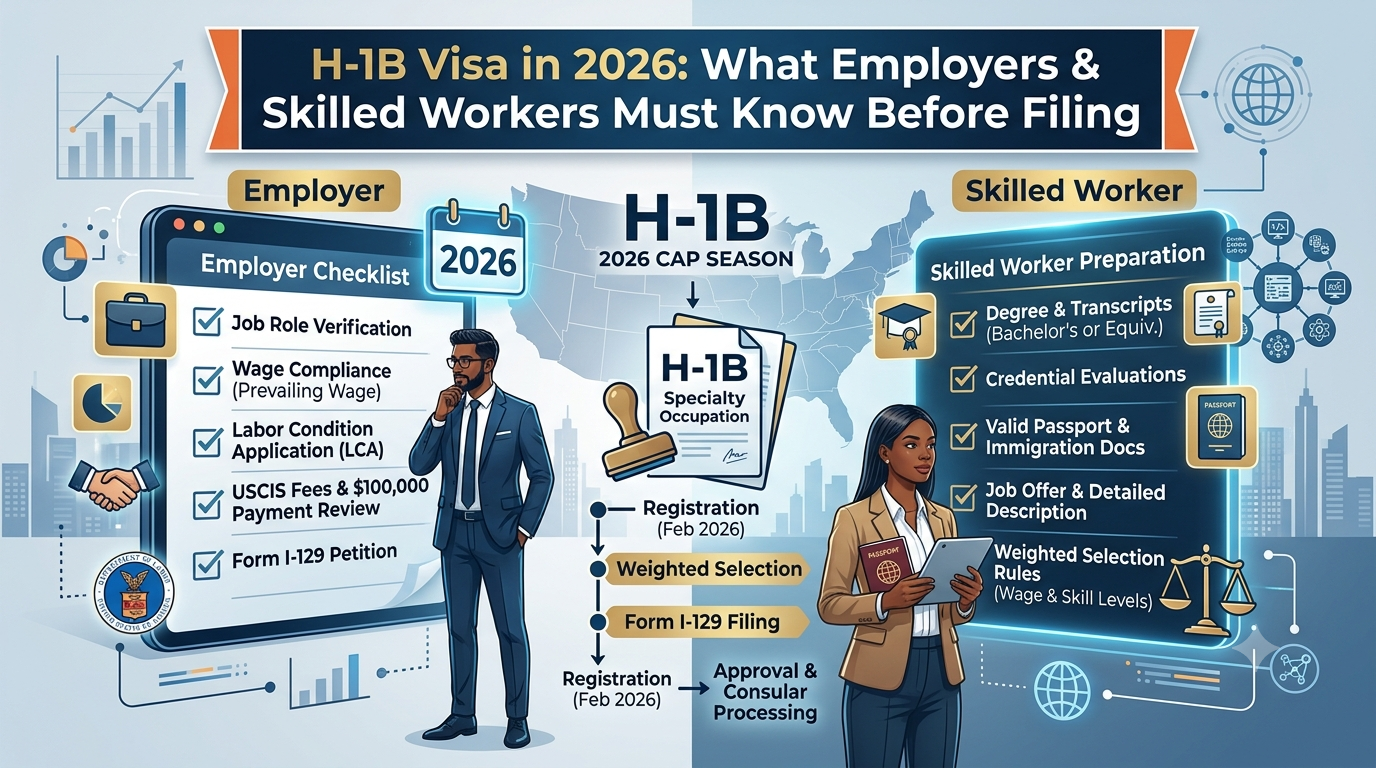
Employers typically file Form I-129, Petition for a Nonimmigrant Worker, after completing the applicable Labor Condition Application (LCA) process with the U.S. Department of Labor.
Official resource: USCIS — H-1B Specialty Occupations.
2. H-1B Selection Changes in 2026
One of the major developments for the FY 2027 H-1B cap season is the move from random selection toward a weighted selection process.
The Department of Homeland Security announced that the new rule takes effect on February 27, 2026, for the FY 2027 registration season. The system gives greater weight to higher-skilled and higher-paid prospective workers while maintaining opportunities across wage levels.
This makes it especially important for employers to review the offered position, appropriate occupational classification, work location, and applicable wage level before registration.
However, a higher salary does not guarantee selection or approval. Employers must still meet all eligibility, registration, and petition requirements.
Official announcement: USCIS — Changes to the H-1B Selection Process.
3. H-1B Filing Costs and the $100,000 Payment Question
Immigration costs are an important consideration for employers planning to sponsor foreign professionals.
Depending on the petition, costs may include registration fees, Form I-129 filing fees, fraud-prevention or other applicable statutory fees, premium processing if requested, and legal or administrative expenses.
A separate policy introduced in September 2025 also established a $100,000 payment requirement for certain H-1B petitions involving workers outside the United States. Its applicability depends on the petition and the governing policy, including applicable exceptions.
Employers should not assume that the $100,000 payment applies to every H-1B case. USCIS guidance and the applicable proclamation must be reviewed before filing or making hiring commitments. In particular, certain petitions involving changes of status or extensions for individuals already in the United States may be treated differently.
Before budgeting for a petition, employers should:
- Identify whether the case involves consular processing, a change of status, an extension, or an amendment.
- Confirm which fees and additional payments apply to that specific petition.
- Review the current USCIS fee schedule.
- Obtain advice from qualified immigration counsel where the policy’s application is uncertain.
Official resources:
4. Employer Compliance: More Than Filing Paperwork
Sponsoring an H-1B professional involves ongoing legal responsibilities. Employers must ensure that their petition and actual employment arrangements comply with applicable immigration and labor requirements.
Wage compliance
Employers must comply with the applicable H-1B wage rules. Generally, the required wage is the higher of the employer’s actual wage for similarly employed workers or the prevailing wage for the occupation and area of intended employment.
The LCA also includes attestations concerning working conditions and other employer obligations.
Job duties and qualifications
The offered position must qualify as a specialty occupation, and the employee’s education or equivalent qualifications must satisfy the requirements for the role.
Employers should maintain documentation connecting the position’s actual duties to the required specialized knowledge.
Worksite changes and third-party placements
Worksite arrangements can affect compliance obligations. Employers should assess whether a change in work location requires an amended petition or other action.
Third-party placements may require additional evidence about the assignment, job duties, and employer-employee relationship.
Recordkeeping and inspections
Employers should maintain accurate payroll records, LCA documentation, petition materials, and other required records. They should also be prepared to respond appropriately to lawful compliance inquiries or site visits.
Official resource: U.S. Department of Labor — H-1B Program Requirements.
5. H-1B Applicant Checklist for 2026
Foreign professionals can help reduce avoidable delays by preparing their documents early and communicating with their sponsoring employer.
Before a petition is filed, review the following:
- Valid passport and relevant immigration documents
- Degree certificates, transcripts, and credential evaluations where applicable
- Resume and employment history
- Documentation of relevant professional experience
- Job offer and detailed job description
- Previous H-1B approval notices, if applicable
- Current immigration status and authorized stay, if already in the United States
- Any additional evidence requested by the employer or immigration attorney
The exact evidence required depends on the applicant’s circumstances and the type of petition.
Applicants should also remember that H-1B registration selection is not the same as petition approval. The employer must still submit a properly supported petition, and USCIS must determine whether the legal requirements are met.
6. Common H-1B Mistakes Employers and Applicants Should Avoid
Treating selection as final approval
Selection generally permits the employer to proceed with a cap-subject petition; it does not guarantee approval.
Using an inaccurate job description
A generic job description may fail to demonstrate the specialized duties and qualifications required for the position. Employers should describe the actual work accurately.
Ignoring wage and worksite requirements
A petition can create compliance risks if the employment arrangement does not match the applicable wage, worksite, or documentation requirements.
Relying on outdated fee information
Immigration fees and policy requirements can change. Verify current official guidance before filing.
Making assumptions about employment authorization
A pending petition, job offer, or approval notice does not automatically authorize every person to begin working in every circumstance. Employers and applicants should verify the specific authorization and start-date requirements.
7. How Employers Can Prepare for Future H-1B Filing Seasons
A structured preparation process can help organizations manage deadlines and reduce administrative problems.
Step 1: Review workforce requirements. Identify positions that genuinely require specialized professional knowledge and determine which roles may need sponsorship.
Step 2: Assess eligibility early. Review the job duties, qualifications, work location, and proposed compensation.
Step 3: Plan the budget. Estimate applicable filing fees, legal costs, and any additional payments that may apply to the case.
Step 4: Prepare documentation. Gather company information, job descriptions, wage details, and employee qualifications before the registration or filing deadline.
Step 5: Monitor official announcements. Check USCIS and Department of Labor guidance for updated deadlines, filing instructions, and compliance requirements.
Step 6: Obtain professional review. For complex cases, changing employment arrangements, or uncertain fee requirements, consult a qualified U.S. immigration attorney.
Conclusion
The H-1B process in 2026 requires careful planning from both employers and foreign professionals. Changes to selection procedures, filing costs, and compliance expectations make it important to verify requirements before submitting a registration or petition.
Employers should focus on accurate job documentation, appropriate wage practices, and compliant employment arrangements. Applicants should keep their qualifications and immigration records organized and understand that selection does not guarantee approval.
By using official government guidance and preparing early, organizations and skilled professionals can approach the H-1B process with greater clarity and fewer avoidable mistakes.
Need help understanding an H-1B case? H1BRelief can publish educational resources to help applicants and employers understand common immigration procedures. For advice about a specific case, consult a qualified U.S. immigration attorney.
Disclaimer: This article is for general educational purposes only and is not legal advice. Immigration rules and fee requirements may change. Confirm current requirements with USCIS, the U.S. Department of Labor, and qualified immigration counsel before acting.
Comments