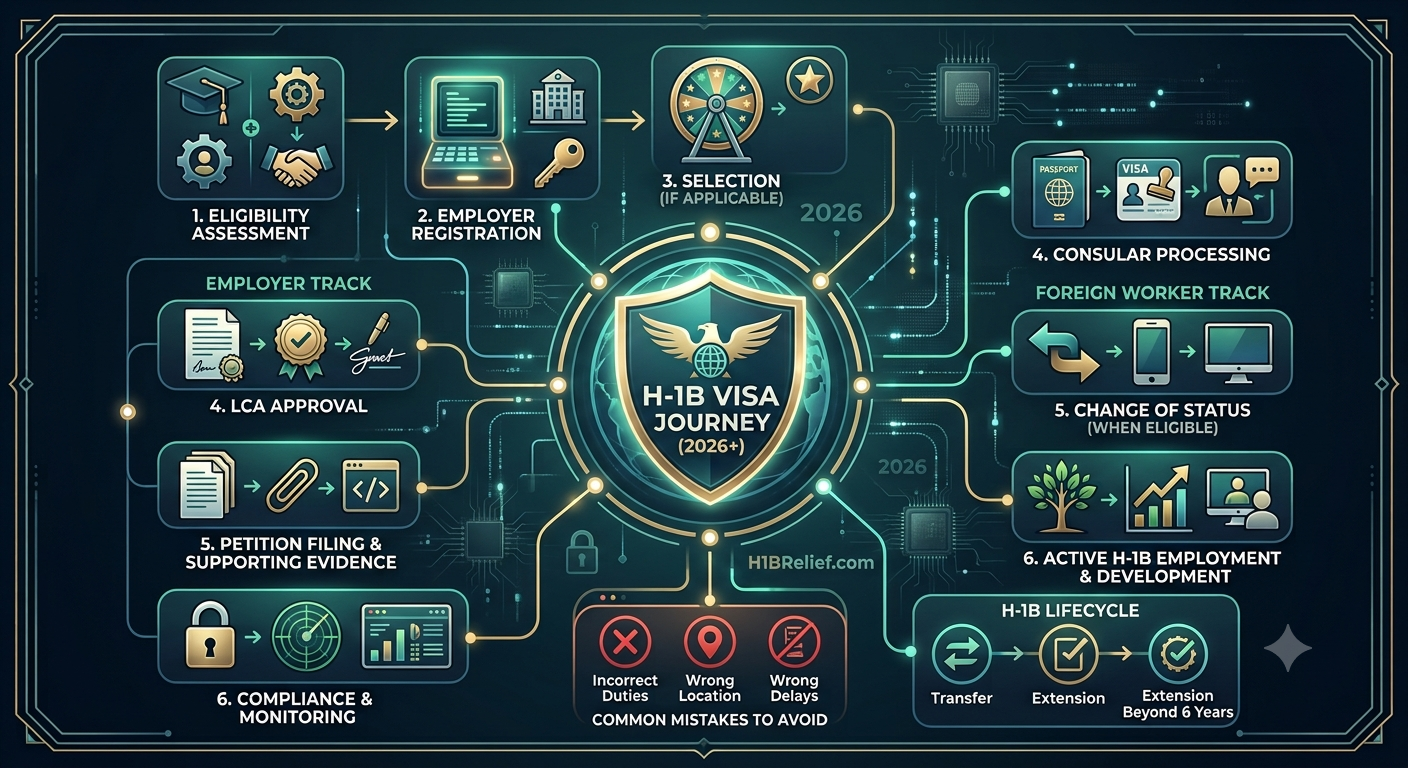
The H-1B visa remains an important U.S. work-visa pathway for qualified foreign professionals working in specialty occupations.
For employers and prospective H-1B workers, the process involves multiple stages, including eligibility assessment, employer sponsorship, registration, selection when applicable, petition preparation, and compliance with U.S. immigration requirements.
Because immigration rules and procedures can change, applicants and employers should always verify current requirements with official U.S. government resources or qualified immigration professionals before taking action.
What Is an H-1B Visa?
The H-1B is a temporary U.S. nonimmigrant classification that allows employers to hire foreign workers in qualifying specialty occupations.
Specialty occupations generally require the application of highly specialized knowledge and attainment of a bachelor’s degree or higher in a directly related specialty, or an equivalent qualification under applicable rules.
H-1B workers can be employed in areas such as:
- Software development
- Information technology
- Engineering
- Data science
- Finance
- Healthcare
- Architecture
- Research
- Business and technology
- Other qualifying professional fields
The employer plays a central role because the H-1B process is generally employer-sponsored.
How Does the H-1B Process Work?
The process can be broadly divided into several stages.
1. Determine H-1B Eligibility
Before beginning the process, the employer and worker should determine whether the position and worker meet the applicable requirements.
Important considerations include:
- Nature of the job
- Specialty occupation requirements
- Educational qualifications
- Degree-to-position relationship
- Employer requirements
- Work location
- Wage requirements
- Immigration history
A careful eligibility review can help identify potential issues before registration or petition preparation.
2. H-1B Registration
For cap-subject cases, employers generally participate in the electronic H-1B registration process during the applicable USCIS registration period.
The employer provides required information about the prospective worker and position.
If the registration is selected, the employer may then have an opportunity to file an H-1B petition during the designated filing period.
The registration stage should not be confused with H-1B approval. Registration and petition adjudication are separate stages.
3. Selection and Petition Filing
If a registration is selected, the employer can generally proceed with preparing the H-1B petition according to USCIS requirements and the applicable filing period.
The petition package may include documentation relating to:
- Employer
- Beneficiary
- Job position
- Educational qualifications
- Offered wage
- Work location
- Specialty occupation
- Supporting evidence
The documentation should accurately represent the actual employment arrangement.
4. Labor Condition Application
The employer generally needs an approved Labor Condition Application (LCA) from the U.S. Department of Labor for an H-1B petition.
The LCA relates to employment conditions and wage obligations.
Employers should ensure that required wage and working-condition requirements are properly addressed.
5. H-1B Petition Review
USCIS reviews the petition and supporting documentation.
Depending on the case, USCIS may:
- Approve the petition
- Issue a Request for Evidence (RFE)
- Issue another notice
- Deny the petition
An RFE does not automatically mean that an H-1B case will be denied. It means USCIS is requesting additional information or evidence before making a decision.
6. Visa Processing or Change of Status
The next steps depend on the worker’s circumstances.
For an individual outside the United States, the process may involve visa application and consular processing after petition approval.
For an eligible individual already in the United States, the employer may request a change of status when permitted.
The correct procedure depends on the individual’s immigration history and circumstances.
H-1B Requirements for Employers
Employers sponsoring H-1B workers should understand their responsibilities.
These may include:
- Filing the required immigration documentation
- Paying applicable filing fees
- Meeting wage obligations
- Maintaining required records
- Following applicable employment conditions
- Providing required notices
- Maintaining accurate petition information
- Reporting certain employment changes when required
H-1B sponsorship is therefore not simply a paperwork exercise. Employers need appropriate processes for immigration compliance throughout the employment relationship.
H-1B Requirements for Workers
Prospective H-1B workers should carefully review their qualifications and employment information.
Important factors can include:
Educational Qualification
The worker generally needs to meet the educational requirements associated with the specialty occupation.
Job Duties
The actual job duties matter. The position should be evaluated based on its responsibilities and requirements rather than relying only on a job title.
Employer Sponsorship
The H-1B petition is generally filed by the U.S. employer on behalf of the prospective worker.
Work Location
The intended work location can affect immigration documentation and compliance requirements.
Common H-1B Mistakes to Avoid
H-1B cases can involve extensive documentation, and inconsistencies may create complications.
Mistake 1: Using an Inaccurate Job Description
The position description should accurately reflect the actual role.
Mistake 2: Ignoring Work Location
Work location is an important part of H-1B documentation and should be accurately represented.
Mistake 3: Inconsistent Documentation
Information across the petition, employment documents, educational records, and other supporting materials should be consistent.
Mistake 4: Waiting Until the Last Minute
H-1B processes involve deadlines and multiple documents. Employers should plan well in advance.
Mistake 5: Assuming Registration Equals Approval
Registration selection is not the same as H-1B petition approval.
Mistake 6: Relying on Outdated Information
Immigration procedures can change. Information from previous H-1B seasons may not necessarily apply to the current process.
H-1B Transfer and Change of Employer
H-1B workers may have options for changing employers under applicable immigration rules.
An H-1B transfer generally involves a new employer filing the required petition.
The worker’s specific circumstances can affect:
- Filing requirements
- Employment start timing
- Status
- Previous immigration history
- Required documentation
Workers should obtain case-specific immigration advice before changing employment if their status depends on H-1B employment.
H-1B Extension
H-1B status is generally granted for an initial period and may be extended under applicable rules.
Employers should monitor expiration dates and begin extension planning early.
An extension case can involve updated information about:
- Job duties
- Salary
- Work location
- Employer
- Immigration status
- Previous H-1B approvals
H-1B Compliance for Employers
H-1B compliance continues after petition approval.
Employers should maintain processes for monitoring changes to employment conditions.
Potential areas requiring attention include:
- Worksite changes
- Compensation
- Job duties
- Employer changes
- Employment termination
- Required notices
- Public access records
- Immigration documentation
A change that appears operationally minor can sometimes have immigration implications.
H-1B and Technology Professionals
Technology companies are among the employers that frequently use H-1B sponsorship for specialized professional roles.
Potential positions can include:
- Software Engineer
- Full Stack Developer
- Data Engineer
- Cloud Engineer
- DevOps Engineer
- AI/ML Engineer
- Cybersecurity Specialist
- Solutions Architect
- Database Engineer
- Product Specialist
However, the job title alone does not establish H-1B eligibility. The actual position requirements and applicable immigration rules need to be evaluated.
How H1BRelief Can Help
H1BRelief provides information and resources related to the H-1B process for employers, professionals, and organizations navigating U.S. employment immigration.
The platform can help users understand topics such as:
- H-1B registration
- H-1B petition process
- H-1B transfers
- H-1B extensions
- Employer sponsorship
- H-1B documentation
- Immigration process updates
- Common H-1B questions
For case-specific legal advice, users should consult a qualified U.S. immigration attorney or authorized immigration professional.
H-1B FAQ
What is the H-1B visa?
The H-1B is a U.S. temporary nonimmigrant classification for qualifying specialty-occupation workers sponsored by eligible employers.
Who can sponsor an H-1B worker?
A qualifying U.S. employer generally files the H-1B petition for the prospective worker.
Does H-1B registration guarantee approval?
No. Registration and petition approval are separate stages.
Can an H-1B worker change employers?
Under applicable rules, an H-1B worker may be able to change employers through the required petition process.
Can an H-1B visa be extended?
H-1B status may be extendable under applicable immigration rules, subject to the circumstances of the case.
Can an H-1B worker work remotely?
Remote or hybrid work arrangements can have immigration and compliance implications depending on the circumstances, including the work location. Employers should evaluate applicable requirements before changing work arrangements.
How should I prepare for the H-1B process?
Start by reviewing eligibility, employer requirements, job duties, educational qualifications, work location, deadlines, and supporting documentation. Because requirements can change, verify the current process before filing.
Final Thoughts
The H-1B process involves more than submitting a single application. Employers and prospective workers need to understand eligibility, registration, petition filing, labor requirements, documentation, employment conditions, and ongoing compliance.
For the 2026 H-1B cycle and beyond, using current information and planning early can help employers and professionals better understand the process and prepare the appropriate documentation.
H1BRelief can serve as an information resource for people researching H-1B sponsorship, registration, transfers, extensions, employer requirements, and U.S. work immigration.
For individual immigration matters, professional legal advice should be obtained based on the specific facts of the case.
Comments