Introduction
The H-1B visa remains one of the most important U.S. immigration pathways for skilled professionals seeking employment in specialty occupations.
Technology companies, engineering firms, healthcare organizations, financial institutions, research organizations, and other U.S. employers regularly use the H-1B program to hire professionals whose education and expertise match specialized job requirements.
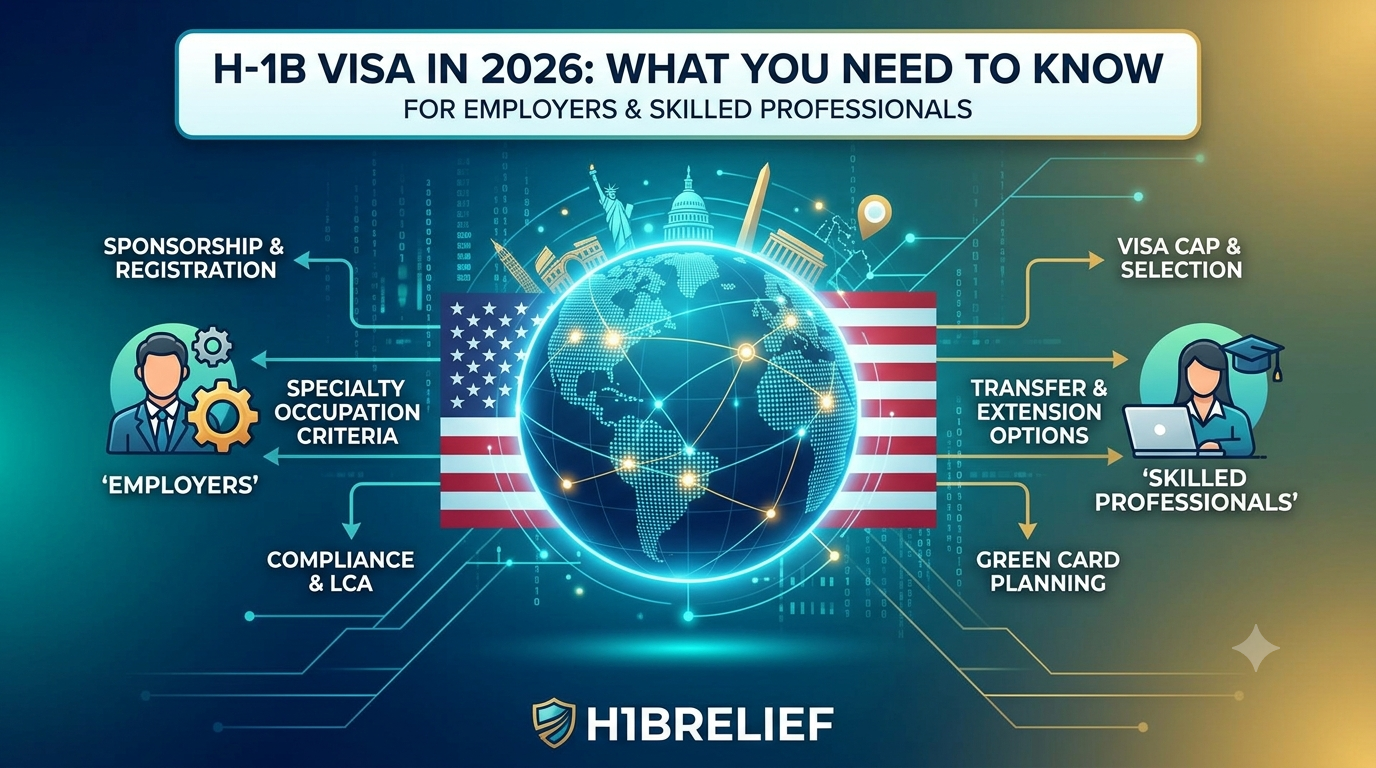
However, the H-1B process involves multiple requirements, including employer sponsorship, specialty occupation criteria, documentation, registration and selection procedures where applicable, and compliance obligations.
In 2026, employers and prospective H-1B workers should pay close attention to the updated regulatory framework and make sure their cases are prepared carefully.
What Is an H-1B Visa?
The H-1B is a temporary U.S. nonimmigrant classification that allows qualifying employers to employ foreign professionals in specialty occupations.
A specialty occupation generally requires specialized knowledge and the attainment of a bachelor’s degree or higher in a directly related specialty, subject to the applicable regulatory requirements.
H-1B occupations commonly include:
- Software development
- Computer science
- Engineering
- Data analytics
- Architecture
- Finance
- Accounting
- Healthcare
- Scientific research
- Information technology
USCIS data shows how important technology-related occupations are within the H-1B program. In FY 2024, computer-related occupations represented 64% of approved H-1B beneficiaries, with systems analysis and programming accounting for the largest detailed occupational group.
How the H-1B Process Works
For many cap-subject H-1B cases, the process begins with electronic registration.
The basic process can involve:
- Employer identifies a qualifying position.
- Employer determines whether H-1B sponsorship is appropriate.
- Employer completes the applicable H-1B registration process.
- USCIS conducts the applicable selection process.
- If selected, the employer files the H-1B petition.
- USCIS reviews the petition.
- If approved, the beneficiary follows the appropriate next steps based on their current immigration status and location.
The exact process can differ depending on whether the individual is already in the United States, changing status, extending H-1B employment, transferring employment, or applying through another applicable pathway.
Understanding the H-1B Cap
The H-1B program has an annual statutory numerical limitation for certain new H-1B workers.
The general cap includes 65,000 H-1B numbers, with an additional 20,000 numbers available for qualifying individuals with a U.S. master’s degree or higher.
Not every H-1B petition is subject to the annual cap.
For example, certain extensions, changes in employment conditions, and petitions involving beneficiaries who have previously been counted against the cap may not be subject to the annual cap.
This distinction is important because an individual’s H-1B strategy depends heavily on their current immigration history and circumstances.
H-1B Modernization Changes
The Department of Homeland Security published a final rule modernizing H-1B requirements, with the rule becoming effective on January 17, 2025.
The modernization rule was designed to clarify H-1B requirements, improve program efficiency, provide certain flexibilities, and strengthen program integrity.
Employers should therefore avoid relying solely on older H-1B information found online.
Immigration rules and agency procedures can change, making it important to verify current requirements before filing.
What Makes a Position a Specialty Occupation?
One of the most important aspects of an H-1B petition is demonstrating that the offered position qualifies as a specialty occupation.
The employer generally needs to show that the position requires specialized knowledge and that the required educational background is appropriately connected to the position.
For example, a software engineering position may require specialized knowledge of:
- Software engineering
- Computer science
- Information technology
- Artificial intelligence
- Data engineering
- Cybersecurity
The job description, degree requirements, employer documentation, and other evidence should present a consistent picture of the position.
Why Job Descriptions Matter
A strong job description can be an important component of an H-1B petition.
The description should clearly explain:
- Job responsibilities
- Required technical skills
- Educational requirements
- Industry-specific knowledge
- Tools and technologies used
- Level of responsibility
- Relationship between education and job duties
Vague descriptions can make it harder to demonstrate why the position requires specialized knowledge.
Employers should ensure that the documentation accurately reflects the actual position.
H-1B for Technology Professionals
Technology remains one of the largest areas of H-1B employment.
Professionals working in areas such as software engineering, cloud computing, cybersecurity, data science, AI, and systems analysis may encounter H-1B sponsorship opportunities when their positions and qualifications satisfy applicable requirements.
Technology employers should carefully document why a particular position requires specialized knowledge and how the beneficiary’s educational background relates to the position.
H-1B Employer Responsibilities
H-1B sponsorship is not simply about submitting a petition.
Employers have important responsibilities related to the employment of H-1B workers.
Depending on the situation, employers may need to address:
- Required wage obligations
- Labor Condition Application requirements
- Employment conditions
- Recordkeeping
- Worksite information
- Immigration compliance
- Required notices
- Petition accuracy
Employers should maintain accurate records and ensure that the information submitted to immigration authorities reflects the actual employment arrangement.
H-1B Transfer and Change of Employer
An H-1B worker may have options for changing employers under applicable immigration rules.
The process can differ from a first-time cap-subject H-1B case.
Employers hiring an existing H-1B worker should review:
- Current H-1B status
- Existing approval notices
- Current employment
- Proposed position
- Work location
- Salary
- Petition history
- Previous H-1B cap counting
The appropriate filing strategy depends on the individual’s circumstances.
H-1B Extensions
H-1B status is generally subject to a maximum period of six years, although certain exceptions may apply.
USCIS explains that an individual can generally be admitted in H-1B status for up to six years, with individual approval periods generally limited to a maximum initial period of three years. Certain statutory exceptions can allow additional time.
Because immigration timelines can become complicated, H-1B workers should plan extensions well before their current status expires.
H-1B and Green Card Planning
For many professionals, the H-1B is part of a longer-term U.S. immigration strategy.
Some H-1B workers eventually explore employment-based permanent residence options.
The appropriate strategy depends on factors such as:
- Employment history
- Country of chargeability
- Employer sponsorship
- Professional qualifications
- Priority date
- Visa availability
- Applicable immigration category
An H-1B holder should not assume that an H-1B approval automatically leads to permanent residence. Separate eligibility requirements and procedures apply.
Common H-1B Mistakes to Avoid
1. Using Outdated Information
Immigration regulations and procedures can change.
Always verify current requirements before filing.
2. Weak Job Descriptions
A generic job description may not adequately explain the specialized nature of a position.
3. Inconsistent Documentation
The petition, employment letter, job description, educational records, and other documents should provide consistent information.
4. Ignoring Worksite Changes
Changes in employment location can have immigration implications depending on the circumstances.
5. Waiting Until the Last Minute
H-1B planning often involves multiple steps and deadlines.
Early preparation can reduce avoidable problems.
6. Treating Every H-1B Case the Same
A new cap-subject petition, transfer, extension, amendment, and change-of-status case can involve different considerations.
How H1BRelief Can Help
H1BRelief is focused on helping H-1B professionals and employers better understand the immigration process and navigate important H-1B-related requirements.
Useful areas of support and information can include:
- H-1B visa guidance
- H-1B registration information
- H-1B transfer information
- H-1B extension guidance
- Employer sponsorship information
- Specialty occupation requirements
- Immigration documentation
- H-1B compliance information
- Long-term immigration planning
Because individual immigration circumstances can vary significantly, applicants should obtain advice appropriate to their specific situation.
Why Staying Updated Matters in 2026
The H-1B program is subject to regulatory changes, agency guidance, filing procedures, and other developments.
USCIS provides online tools for tracking cases and accessing current immigration information.
Applicants and employers should therefore use current official information rather than relying on outdated blog posts, social media discussions, or old filing experiences.
Final Thoughts
The H-1B visa continues to play a major role in helping U.S. employers hire skilled professionals in specialty occupations.
For applicants, successful H-1B planning requires more than simply meeting educational requirements. The position, employer, documentation, immigration history, filing strategy, and applicable regulations all matter.
For employers, careful preparation and compliance are essential throughout the sponsorship process.
In 2026, staying informed about the latest H-1B requirements can help employers and skilled professionals make better decisions and avoid unnecessary mistakes.
H1BRelief provides H-1B-focused information and resources to help professionals and employers better understand the U.S. H-1B immigration process.
Important Note
This article is provided for general informational purposes and should not be considered legal advice. H-1B eligibility and immigration procedures depend on individual circumstances. Always verify current requirements with official U.S. government sources and, when appropriate, consult a qualified U.S. immigration attorney.
Suggested SEO Keywords
Primary Keywords:
H1B visa 2026, H1B visa requirements, H1B visa process, H1B immigration
Secondary Keywords:
H1B sponsorship, H1B transfer, H1B extension, H1B specialty occupation, H1B employer requirements, H1B registration, H1B visa for skilled workers, H1B immigration guide
Suggested Meta Title:
H1B Visa 2026: Requirements, Process & Employer Guide
Suggested Meta Description:
Learn about the H1B visa in 2026, including eligibility, specialty occupations, registration, employer sponsorship, transfers, extensions, and important requirements.
Comments