Introduction
For international professionals pursuing career opportunities in the United States, the H-1B visa remains an important pathway to employment in specialized occupations.
However, navigating the H-1B process requires more than finding a job offer. Applicants and employers must understand registration requirements, petition eligibility, employment documentation, and changing immigration regulations.
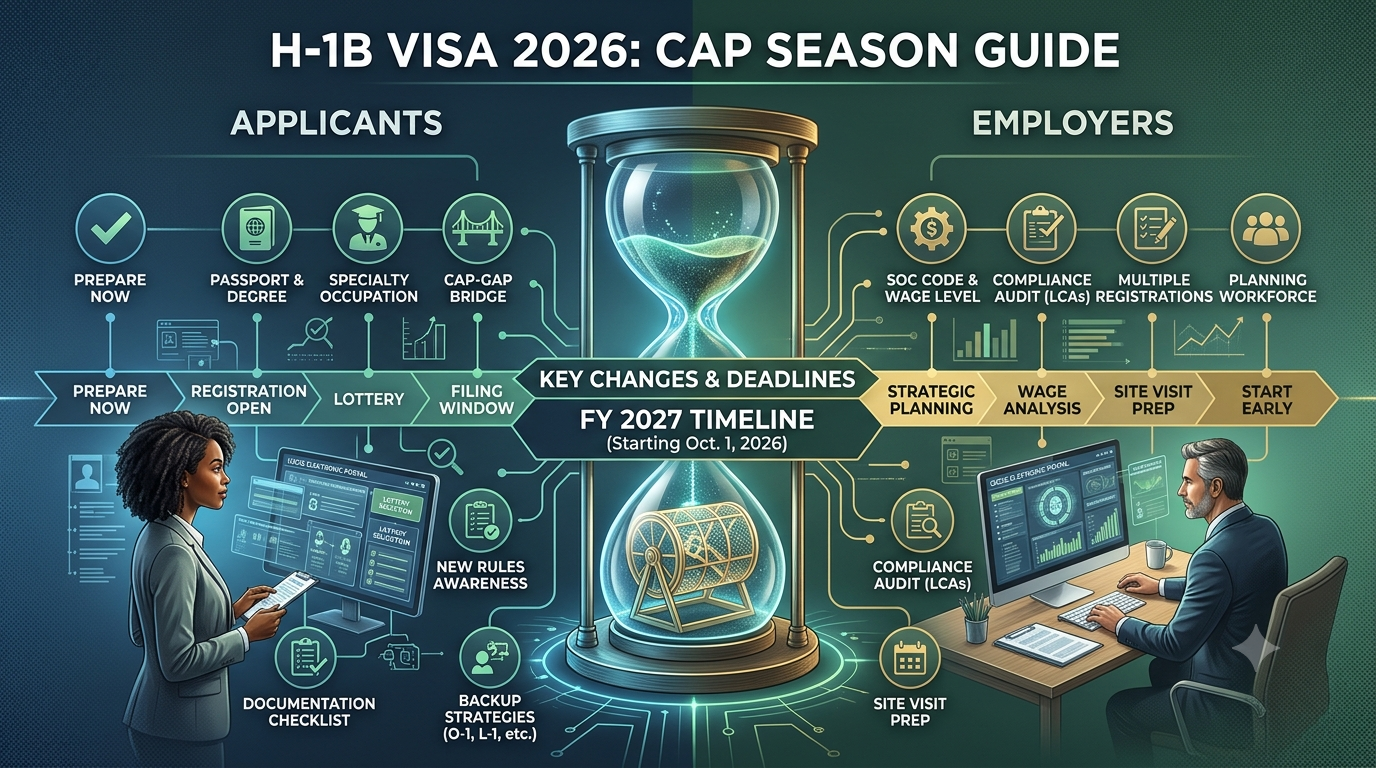
In 2026, the H-1B program has undergone significant changes, including a weighted selection process for the FY 2027 cap season.
For applicants preparing for future opportunities, understanding these developments can help them make better career and immigration decisions.
This guide explains the major H-1B developments in 2026, common application challenges, and practical steps for preparing for the next cap season.
What Is the H-1B Visa?
The H-1B visa is a U.S. nonimmigrant work visa that allows employers to temporarily employ foreign professionals in qualifying specialty occupations.
A specialty occupation generally requires the theoretical and practical application of specialized knowledge and a bachelor’s degree or higher in a directly related specific specialty, or its equivalent.
H-1B employment opportunities can include roles in:
- Software development and information technology.
- Engineering and technical consulting.
- Data science and analytics.
- Scientific research.
- Accounting and finance.
- Certain healthcare and education occupations.
The employer generally plays a central role in the process by sponsoring the worker and filing the required petition with U.S. Citizenship and Immigration Services (USCIS).
Major H-1B Visa Updates in 2026
The FY 2027 H-1B cap season introduced important changes for employers and prospective applicants.
1. Weighted H-1B Selection Process
One of the major developments is the introduction of a weighted selection process.
Beginning with the FY 2027 cap season, the selection process generally gives greater weight to registrations associated with higher wage levels under the Department of Labor’s Occupational Employment and Wage Statistics (OEWS) system.
The process is designed to prioritize higher-skilled and higher-paid workers while maintaining opportunities across wage levels.
This means that employers should carefully evaluate the offered position, wage level, occupation classification, and work location when preparing registrations.
A higher wage level does not guarantee selection.
2. FY 2027 Registration Period Has Closed
USCIS announced that the FY 2027 H-1B initial registration period ran from March 4 through March 19, 2026.
The registration fee was $215 per beneficiary.
USCIS completed the initial selection process and notified employers with selected beneficiaries.
For FY 2027, only employers with selected registrations were eligible to file cap-subject H-1B petitions during the designated filing period.
Applicants who were not selected should understand that an unselected registration does not automatically carry forward into the next fiscal year.
3. Additional Fee Considerations
Certain H-1B petitions may be subject to additional payment requirements under the September 2025 presidential proclamation concerning H-1B workers.
The applicability of the additional $100,000 payment depends on the petition and the circumstances covered by the proclamation.
Employers should review the applicable USCIS guidance and obtain qualified legal advice before filing.
Not every H-1B petition is subject to the same fee requirements.
H-1B Visa Eligibility Requirements
Understanding eligibility is an important first step for prospective H-1B applicants.
Educational Qualifications
Applicants generally need a bachelor’s degree or higher in a field directly related to the specialty occupation, or an equivalent qualification.
Depending on the circumstances, qualifying professional experience and educational evaluations may be relevant.
Specialty Occupation
The offered position must meet the specialty occupation requirements.
A job title alone does not establish eligibility. The duties, educational requirements, and other relevant evidence are important.
Employer Sponsorship
An eligible U.S. employer generally must offer the qualifying position and file the required petition.
Applicants cannot independently file an ordinary cap-subject H-1B petition without an eligible petitioner.
Supporting Documentation
Depending on the case, documentation may include:
- Educational certificates and transcripts.
- Degree equivalency evaluations.
- Employment offer letters.
- Job descriptions.
- Employer information.
- Passport or travel document details.
- Evidence supporting the offered wage and position.
The exact requirements vary by case.
How to Prepare for the Next H-1B Cap Season
Although future registration dates should be confirmed through official USCIS announcements, applicants and employers can begin preparing well in advance.
Step 1: Identify Potential Sponsoring Employers
Applicants should focus on employers with relevant positions and a willingness to sponsor eligible candidates.
Researching employers early can help applicants understand job requirements and sponsorship expectations.
Step 2: Prepare Educational Documents
Keep academic transcripts, degree certificates, and relevant professional records organized.
Applicants with degrees earned outside the United States may need an educational evaluation depending on the circumstances.
Step 3: Review the Job Description
The offered position should clearly describe the specialized responsibilities and qualifications required.
Employers should ensure that the job description, occupation classification, and wage information are consistent.
Step 4: Understand the Registration Process
H-1B cap registration is generally completed electronically through a USCIS online account by the prospective employer or its authorized representative.
Applicants should communicate with their prospective employers and ensure that the information provided is accurate.
Step 5: Monitor Official USCIS Announcements
Future registration dates, fees, and filing requirements can change.
Applicants and employers should rely on official USCIS announcements rather than social media rumors or unverified immigration updates.
Common H-1B Visa Mistakes to Avoid
Assuming Registration Means Approval
Registration selection only provides eligibility to file a cap-subject petition.
It does not mean that USCIS has approved the H-1B petition.
Providing Inconsistent Information
Differences in passport details, job descriptions, wage information, or employer records can create complications.
All information should be reviewed carefully before submission.
Ignoring Wage-Level Requirements
The weighted selection process makes wage-level information especially important.
Employers should use accurate information for the relevant occupation and intended employment location.
Waiting Until the Last Minute
Last-minute preparation can increase the risk of missing documents, incorrect information, and filing delays.
Early preparation can help applicants and employers manage the process more efficiently.
Relying on Unverified Immigration Advice
Immigration rules can change, and individual cases may involve different legal considerations.
Applicants should consult official sources and qualified immigration professionals when evaluating their circumstances.
What Happens If Your H-1B Registration Is Not Selected?
Not being selected can be disappointing, but applicants may have other options depending on their qualifications and immigration circumstances.
Possible alternatives may include:
- Preparing for a future H-1B cap season.
- Exploring eligible cap-exempt employment opportunities.
- Reviewing other employment-based immigration categories.
- Considering whether another lawful immigration status may be available.
- Discussing potential options with a qualified immigration attorney.
Not every alternative is available to every applicant. Eligibility depends on individual circumstances and applicable immigration law.
How H1BRelief Can Help You Navigate the Process
The H-1B process can be confusing for applicants and employers, especially when regulations, fees, and filing requirements change.
H1BRelief provides an opportunity for individuals to learn about H-1B immigration requirements, understand common application challenges, and identify questions they may need to discuss with a qualified immigration professional.
Whether you are preparing for a future H-1B cap season, reviewing your employment situation, or researching sponsorship requirements, reliable information is an important starting point.
Understanding the process early can help you make informed decisions about your professional future.
Conclusion
The H-1B visa process continues to evolve, and 2026 has introduced important developments for applicants and employers.
The weighted selection process, registration requirements, and additional fee considerations make accurate preparation increasingly important.
Applicants should focus on identifying suitable employers, organizing their educational documents, understanding their eligibility, and monitoring official USCIS updates.
Employers should carefully review position requirements, wage information, and filing obligations before submitting registrations and petitions.
The next H-1B opportunity may require preparation well before registration opens.
Stay informed. Prepare early. Make your next career move with confidence.
Visit H1BRelief to explore H-1B visa information and immigration guidance.
Frequently Asked Questions
What is the H-1B visa in the United States?
The H-1B visa is a temporary work visa for qualifying specialty occupations that generally require specialized knowledge and a directly related bachelor’s degree or equivalent.
Is the H-1B lottery still random in 2026?
The FY 2027 cap season introduced a weighted selection process that generally prioritizes registrations associated with higher wage le
Comments