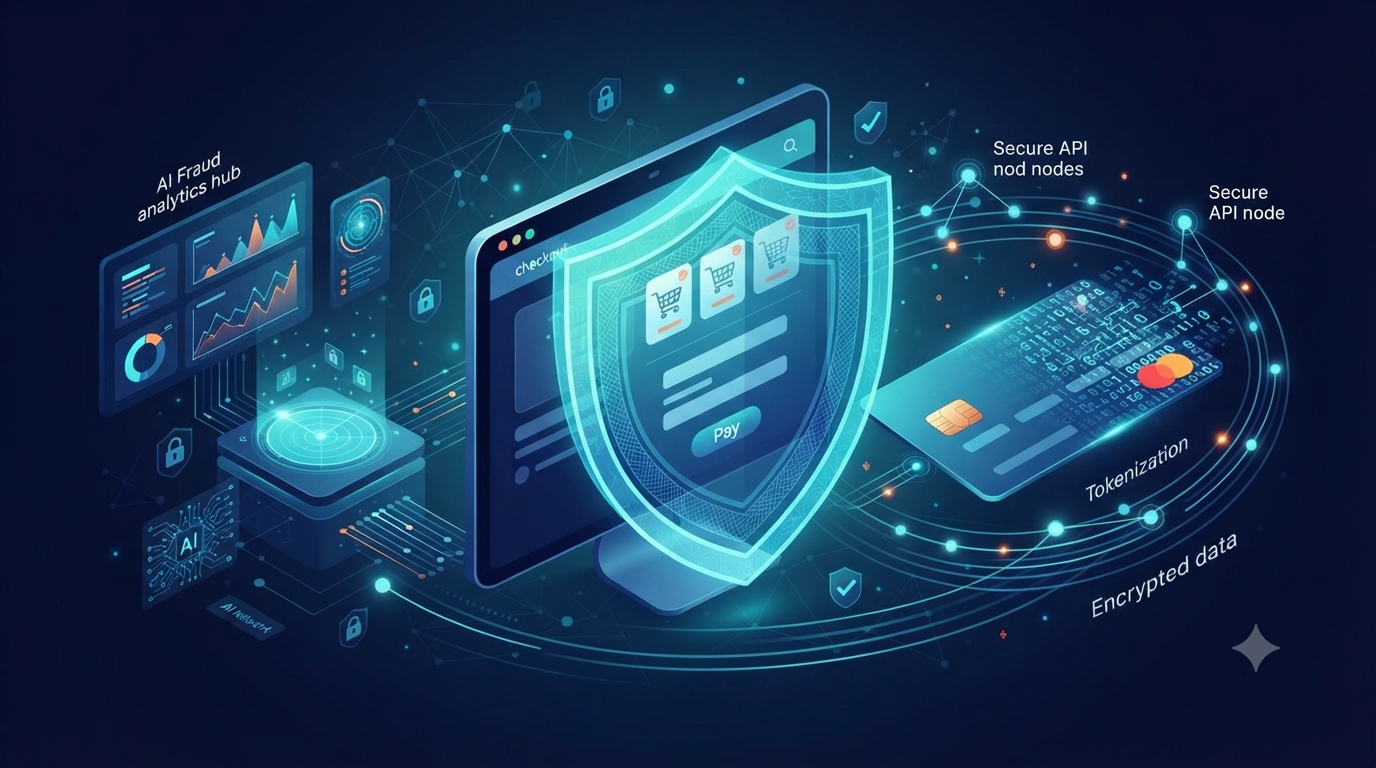
Online shopping has transformed the way businesses sell products and customers make payments. From small online stores to large eCommerce marketplaces, digital checkout systems have become an essential part of modern commerce.
However, as online transactions increase, payment security has become a major concern for businesses. Cybercriminals continuously look for vulnerabilities in checkout pages, payment integrations, third-party scripts, and customer authentication systems.
A compromised checkout experience can expose sensitive payment information, damage customer trust, and create significant financial and operational consequences.
In 2026, businesses need more than a functional payment gateway. They need secure payment application architectures that protect transactions throughout the checkout journey.
This is why eCommerce payment security and PCI DSS compliance should be essential considerations when developing modern online payment applications.
1. Understand the Security Risks of Online Checkout Systems
An eCommerce checkout process involves multiple components, including shopping carts, payment gateways, customer accounts, APIs, and external services.
Every connected component introduces potential security considerations.
Some common risks include:
- Payment card data theft.
- Malicious JavaScript injected into checkout pages.
- Compromised third-party scripts.
- Weak customer authentication.
- Insecure payment APIs.
- Phishing and fraudulent transactions.
- Vulnerable plugins and outdated software.
- Unauthorized access to payment environments.
Businesses must evaluate their entire checkout environment instead of focusing exclusively on payment gateway security.
2. Protect Checkout Pages Against E-Skimming Attacks
One emerging concern for online retailers is digital payment skimming.
In an e-skimming attack, cybercriminals inject malicious scripts into checkout pages to capture sensitive information entered by customers.
These attacks can be particularly dangerous because the checkout page may continue functioning normally while customer information is being compromised.
Businesses can strengthen checkout security through:
Script Authorization: Maintain control over which scripts are allowed to execute on payment pages.
Script Inventory: Keep an inventory of scripts used throughout the checkout process.
Change Detection: Monitor payment pages for unauthorized modifications.
Content Security Policy: Implement suitable browser security policies to restrict unauthorized script execution.
Third-Party Review: Evaluate external scripts, plugins, and integrations before adding them to payment pages.
These practices help reduce the risk of unauthorized changes and improve visibility into checkout page security.
3. Implement PCI DSS Requirements for Payment Page Security
PCI DSS establishes security requirements for organizations that store, process, or transmit payment account data and other organizations within its scope.
PCI DSS 4.0.1 includes important requirements related to payment page security.
Two particularly relevant requirements are:
- Requirement 6.4.3: Addresses the management and authorization of payment page scripts, including mechanisms to assure their integrity and maintain an inventory with business justification.
- Requirement 11.6.1: Addresses mechanisms for detecting unauthorized changes to payment pages and security-impacting HTTP headers as received by the consumer browser.
These controls are especially important for eCommerce environments where payment pages depend on multiple scripts and third-party integrations.
Businesses should assess their actual PCI DSS scope and applicable validation requirements rather than assuming every checkout implementation has identical obligations.
4. Use Secure Payment Gateway Integrations
Payment gateways connect online stores with payment processors and financial institutions.
A properly integrated payment gateway helps businesses accept digital transactions without building every payment-processing component from scratch.
However, integration quality plays an important role in application security.
Development teams should consider:
- Secure API authentication.
- Encrypted communication.
- Proper webhook signature verification.
- Idempotency controls for payment requests.
- Secure handling of API credentials.
- Input validation.
- Transaction status verification.
- Appropriate error and logging practices.
Webhook verification is particularly important because payment applications often receive transaction updates from external payment services.
Applications should never rely solely on an unverified callback to confirm a successful payment.
5. Reduce Payment Data Exposure Through Tokenization
Tokenization allows businesses to reduce their direct exposure to sensitive payment information.
Instead of storing actual payment card details, an authorized payment provider can generate a token representing the payment account.
The application can then use the token for supported operations such as recurring billing or subsequent transactions.
Some key advantages include:
- Reduced handling of sensitive card information.
- Better protection of stored payment references.
- Support for recurring payment workflows.
- Improved integration with payment service providers.
- Potential reduction in PCI DSS scope.
However, tokenization does not automatically remove all compliance obligations. The implementation, systems involved, and payment environment must still be assessed.
6. Strengthen Customer Authentication and Fraud Prevention
Online businesses must balance convenient checkout experiences with appropriate security controls.
Weak authentication can expose customer accounts to credential theft, account takeover, and fraudulent transactions.
Modern payment applications can incorporate several protective measures:
Multi-Factor Authentication: Introduce additional authentication where appropriate and required.
Risk-Based Authentication: Apply additional verification when transactions exhibit suspicious characteristics.
3D Secure: Integrate supported authentication protocols for eligible card transactions.
Account Protection: Implement rate limiting, secure session management, and protection against credential stuffing.
Fraud Monitoring: Monitor transaction patterns and identify unusual payment behavior.
These capabilities can help businesses create safer checkout experiences without introducing unnecessary friction for every customer.
7. Secure Third-Party Payment Components
Modern eCommerce platforms frequently depend on third-party services for analytics, customer support, marketing automation, payment processing, and fraud detection.
Although these services provide valuable functionality, they can also introduce security risks.
For example, an outdated plugin or compromised external script may create an opportunity for unauthorized access or data collection.
Businesses should:
- Maintain an inventory of third-party components.
- Review security and integration requirements.
- Remove unnecessary scripts and plugins.
- Monitor updates and vulnerabilities.
- Restrict access to sensitive systems.
- Review third-party service provider responsibilities.
- Regularly test critical payment workflows.
Third-party security should be treated as an ongoing responsibility rather than a one-time integration task.
8. Integrate Payment Security Into Application Development
Payment security should be considered from the beginning of the software development lifecycle.
A secure development process helps identify vulnerabilities before they reach production.
Important development practices include:
- Secure architecture planning.
- Threat modeling.
- Secure coding standards.
- Static and dynamic application security testing.
- Dependency vulnerability scanning.
- API security assessments.
- Penetration testing where appropriate.
- Continuous monitoring.
- Regular security updates.
Development teams should also maintain appropriate documentation and change-management processes.
A well-structured development lifecycle makes it easier to maintain security as payment applications evolve.
9. Prepare for AI-Driven Payment Fraud Detection
Artificial intelligence is creating new opportunities for identifying suspicious payment activity.
AI-based systems can analyze transaction patterns and help businesses recognize unusual behavior that may indicate fraudulent activity.
Potential applications include:
- Transaction anomaly detection.
- Suspicious purchase pattern identification.
- Automated fraud alerts.
- Customer behavior analysis.
- Risk-based transaction monitoring.
- Fraud investigation support.
However, AI-based fraud detection should complement established security controls. Businesses must also evaluate data privacy, model security, accuracy, and human oversight.
How PCIAppDeveloper Can Help Build Secure Payment Applications
Building a secure eCommerce payment application requires more than connecting a shopping cart to a payment gateway.
Businesses need a reliable architecture that considers payment workflows, API security, data protection, third-party integrations, and applicable compliance requirements.
PCIAppDeveloper focuses on payment application development and secure software engineering considerations to help businesses develop payment technology aligned with their operational requirements.
Whether you are creating a new eCommerce payment application, integrating payment gateways, upgrading an existing checkout system, or developing custom payment functionality, security should remain a priority throughout the development process.
Conclusion
The future of eCommerce depends on convenient and trustworthy digital payment experiences.
As online checkout systems become more interconnected, protecting payment pages, securing APIs, managing third-party scripts, and addressing PCI DSS requirements will remain important responsibilities for businesses.
In 2026, organizations should adopt a security-first approach to payment application development.
By combining secure architecture, payment gateway integration, tokenization, authentication, and continuous security testing, businesses can build stronger foundations for digital commerce.
PCIAppDeveloper can help businesses approach payment application development with a focus on security, functionality, and scalable technology solutions.
Comments