The H-1B visa remains an important pathway for U.S. employers seeking specialized international talent and for professionals looking to build their careers in the United States. However, the immigration landscape is changing, making it increasingly important for applicants and employers to understand current requirements before taking the next step.
In 2026, changes to the H-1B selection process, filing requirements, employer obligations, and government enforcement have made careful preparation more important than ever.
Whether you are an international professional planning your next career move or a U.S. employer hiring specialized talent, understanding the H-1B process can help you avoid unnecessary delays and compliance issues.
1. Understanding the H-1B Visa Program
The H-1B visa is a U.S. nonimmigrant work visa that allows employers to hire qualified foreign professionals for specialty occupations.
A specialty occupation generally requires specialized knowledge and at least a bachelor’s degree or equivalent in a directly related field.
Common industries that employ H-1B professionals include:
- Information technology and software development
- Engineering and technical services
- Healthcare and specialized research
- Finance and accounting
- Architecture and scientific research
- Data analytics and technology consulting
The employer generally files the H-1B petition on behalf of the worker. Applicants cannot independently obtain an H-1B visa without an eligible petitioning employer.
2. Important H-1B Updates Applicants and Employers Should Know in 2026
The FY 2027 H-1B cap season introduced significant changes that employers and applicants should understand.
Weighted H-1B Selection Process
A new weighted selection process became effective on February 27, 2026, ahead of the FY 2027 registration season.
Rather than treating every registration equally in an oversubscribed selection, the system generally gives greater selection weight to higher-paid positions, while retaining opportunities across wage levels.
This makes accurate job classification, wage information, and employer documentation particularly important. 90 FR 60864+1
FY 2027 Registration Schedule
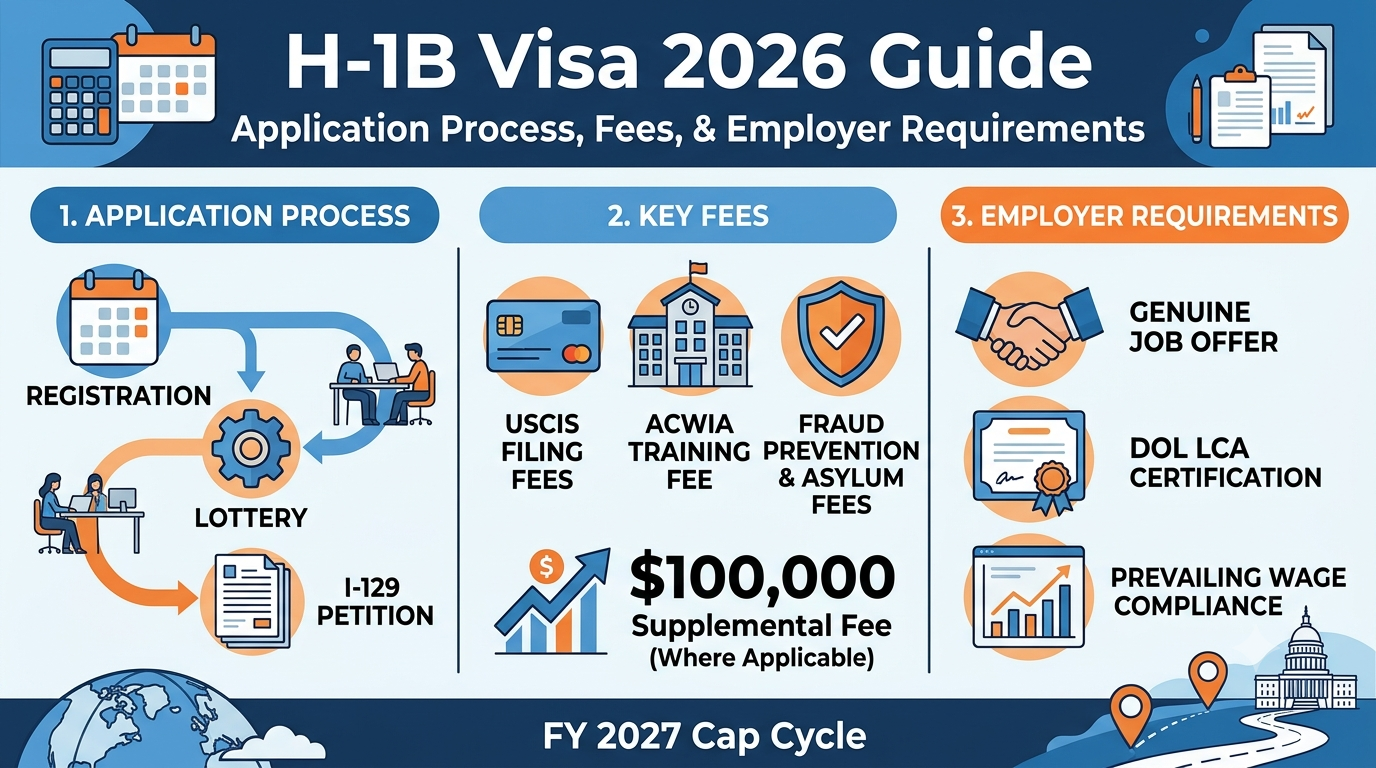
USCIS announced that FY 2027 initial registration opened on March 4 and closed on March 19, 2026. The registration fee was $215 per beneficiary, and selection notifications were expected by March 31.
A selected registration allows the employer to proceed with filing the corresponding H-1B petition; it is not itself an H-1B approval. GovDelivery
Changes to Form I-129
USCIS announced a new edition of Form I-129 dated September 9, 2026. Starting November 9, 2026, it will accept only that edition for applicable filings.
Employers and immigration teams should verify the correct form edition before submitting a petition to avoid rejection. Deja Vu
Additional Fees and Legal Developments
Certain H-1B petitions may also involve additional fee requirements or restrictions depending on the employer and petition circumstances. The legal status of the announced $100,000 payment requirement has been affected by court proceedings and government actions.
Employers should not assume that the requirement applies universally—or that it can be ignored. Confirm the current position with qualified immigration counsel before filing. Deja Vu+1
3. Who Is Eligible for an H-1B Visa?
H-1B eligibility depends on the position, the applicant’s qualifications, and the petitioning employer.
Generally, the applicant must:
- Have a qualifying job offer from a U.S. employer.
- Be offered a position that qualifies as a specialty occupation.
- Hold the required bachelor’s degree or equivalent qualifications in a relevant field.
- Meet any applicable licensing or professional requirements.
- Have an employer willing to complete the required petition and labor condition process.
A degree alone does not guarantee eligibility. The relationship between the job duties and the applicant’s qualifications is an important consideration.
4. Understanding the H-1B Visa Application Process
The H-1B process involves several steps, and applicants should coordinate closely with their employers.
Step 1: Secure a qualifying job offer
The applicant needs a U.S. employer willing to sponsor the H-1B petition.
Step 2: Complete the registration process
For cap-subject cases, the employer or authorized representative generally submits an electronic registration during the USCIS registration period.
Step 3: Wait for selection
If the registration is selected, the employer may proceed with the petition during the designated filing period.
Step 4: File Form I-129
The employer submits Form I-129 with supporting documentation and applicable fees.
Step 5: USCIS reviews the petition
USCIS may approve the petition, issue a Request for Evidence (RFE), or take another action based on the case.
Step 6: Complete the next immigration step
Depending on the applicant’s circumstances, this may involve a change of status in the United States or applying for an H-1B visa at a U.S. consulate.
5. Common H-1B Mistakes That Can Affect an Application
Even a well-qualified applicant can face complications when documentation or filing details are incomplete.
Some common mistakes include:
- Providing inconsistent job descriptions and wage information
- Failing to establish that the position qualifies as a specialty occupation
- Submitting incomplete educational documents
- Missing registration or petition deadlines
- Using outdated immigration forms
- Overlooking employer obligations
- Failing to respond adequately to an RFE
Proper preparation and professional review can help identify potential problems before filing.
6. H-1B Employer Responsibilities: What Companies Must Understand
H-1B sponsorship involves important responsibilities for U.S. employers. Companies must understand their obligations before hiring an international professional.
Key responsibilities include:
- Filing the required Labor Condition Application (LCA) with the Department of Labor.
- Paying the required wage under applicable H-1B rules.
- Maintaining accurate public access and employment records as required.
- Providing appropriate working conditions.
- Reporting relevant employment changes through the proper process.
- Following applicable rules for worksite changes and amended petitions.
The Department of Labor also enforces requirements designed to protect both H-1B workers and U.S. employees. U.S. Department of Labor
7. What Happens If an H-1B Petition Receives an RFE?
A Request for Evidence, commonly known as an RFE, means USCIS needs additional information before making a decision on a petition.
An RFE does not automatically mean that an application will be denied.
Common reasons include:
- Questions about specialty occupation eligibility
- Insufficient evidence of educational qualifications
- Incomplete employer documentation
- Questions about the offered position or job duties
- Concerns about the employment arrangement
The response should address each USCIS request with relevant, consistent supporting documentation. Applicants and employers should carefully follow the response deadline stated in the notice.
8. H-1B Extensions, Transfers, and Future Career Planning
H-1B planning does not end after the initial petition is approved. Professionals may need to consider extensions, employer changes, amendments, or long-term immigration options.
H-1B Extension: Eligible workers may seek an extension of their authorized stay, subject to applicable rules and limits.
H-1B Transfer: A qualifying worker may be able to change employers through a new employer-filed petition, subject to portability requirements.
H-1B Amendment: Certain material changes in employment may require an amended petition.
Long-Term Planning: Some professionals may explore employment-based permanent residence options with their employers.
Each situation is different, so workers should review their immigration history and future plans with a qualified immigration attorney.
9. How H1BRelief Can Help Applicants Navigate the Process
Immigration procedures can be confusing, particularly when requirements, fees, and filing rules change. Reliable information and organized preparation can make the process easier to understand.
H1BRelief aims to help individuals and employers access useful H-1B information, understand common immigration procedures, and prepare for important application-related steps.
Whether you are researching H-1B eligibility, exploring employer sponsorship, or looking for information about extensions and transfers, staying informed is an important part of your immigration journey.
Conclusion: Stay Prepared for the Changing H-1B Landscape
The H-1B visa process in 2026 requires careful attention to registration rules, petition documentation, employer responsibilities, and changing immigration requirements.
For applicants, preparation means understanding eligibility, maintaining accurate records, and working with a legitimate sponsoring employer. For businesses, it means following applicable wage, filing, and compliance obligations.
The most effective approach is to stay informed, prepare documentation early, and seek qualified legal guidance when making immigration decisions.
H1BRelief is committed to making H-1B information easier to understand so applicants and employers can approach the immigration process with greater confidence.
Frequently Asked Questions (FAQs)
Q1. What is the H-1B visa used for?
The H-1B visa allows U.S. employers to temporarily employ qualified foreign professionals in specialty occupations that generally require specialized knowledge and a bachelor’s degree or equivalent.
Q2. What changed in the H-1B selection process in 2026?
A weighted selection process took effect on February 27, 2026, generally favoring higher-paid positions while maintaining opportunities across wage levels.
Q3. Can I apply for an H-1B visa without an employer?
Generally, no. An eligible U.S. employer must file the H-1B petition on behalf of the worker.
Q4. What is an H-1B RFE?
An RFE is a Request for Evidence issued by USCIS when additional information or documentation is needed to evaluate a petition.
Q5. Can I change employers while working on an H-1B visa?
Eligible H-1B workers may be able to change employers through H-1B portability provisions, provided the applicable legal requirements are met.
Q6. How long can someone stay in H-1B status?
H-1B status is generally limited to six years, although certain exceptions may allow extensions beyond that period.
Comments