The H-1B visa remains one of the most important U.S. work visa categories for foreign professionals seeking employment in specialty occupations.
Technology, engineering, finance, healthcare, research, consulting, and other specialized industries regularly use the H-1B program to employ qualified professionals in the United States.
However, the H-1B process has several stages, and the rules and procedures can change between fiscal years.
For applicants and employers preparing for the 2026 H-1B visa process, understanding eligibility, electronic registration, selection, petition filing, employer requirements, and timing is essential.
USCIS describes H-1B as a nonimmigrant classification for individuals coming to the United States to perform services in a specialty occupation.
Important: Immigration rules and procedures can change. Applicants should verify current requirements directly with USCIS and, when appropriate, consult a qualified U.S. immigration attorney.
What Is an H-1B Visa?
The H-1B visa allows U.S. employers to temporarily employ foreign workers in qualifying specialty occupations.
A specialty occupation generally requires the application of specialized knowledge and the attainment of a bachelor’s degree or higher in a directly related specialty, or an equivalent qualification under applicable rules.
Common H-1B occupations can include:
- Software developers
- Data scientists
- IT professionals
- Engineers
- Financial analysts
- Architects
- Researchers
- Healthcare professionals
- Business and technology specialists
- Other qualifying specialty occupations
The actual eligibility of a position depends on the requirements of the specific job and the applicable immigration rules.
How the H-1B Process Works
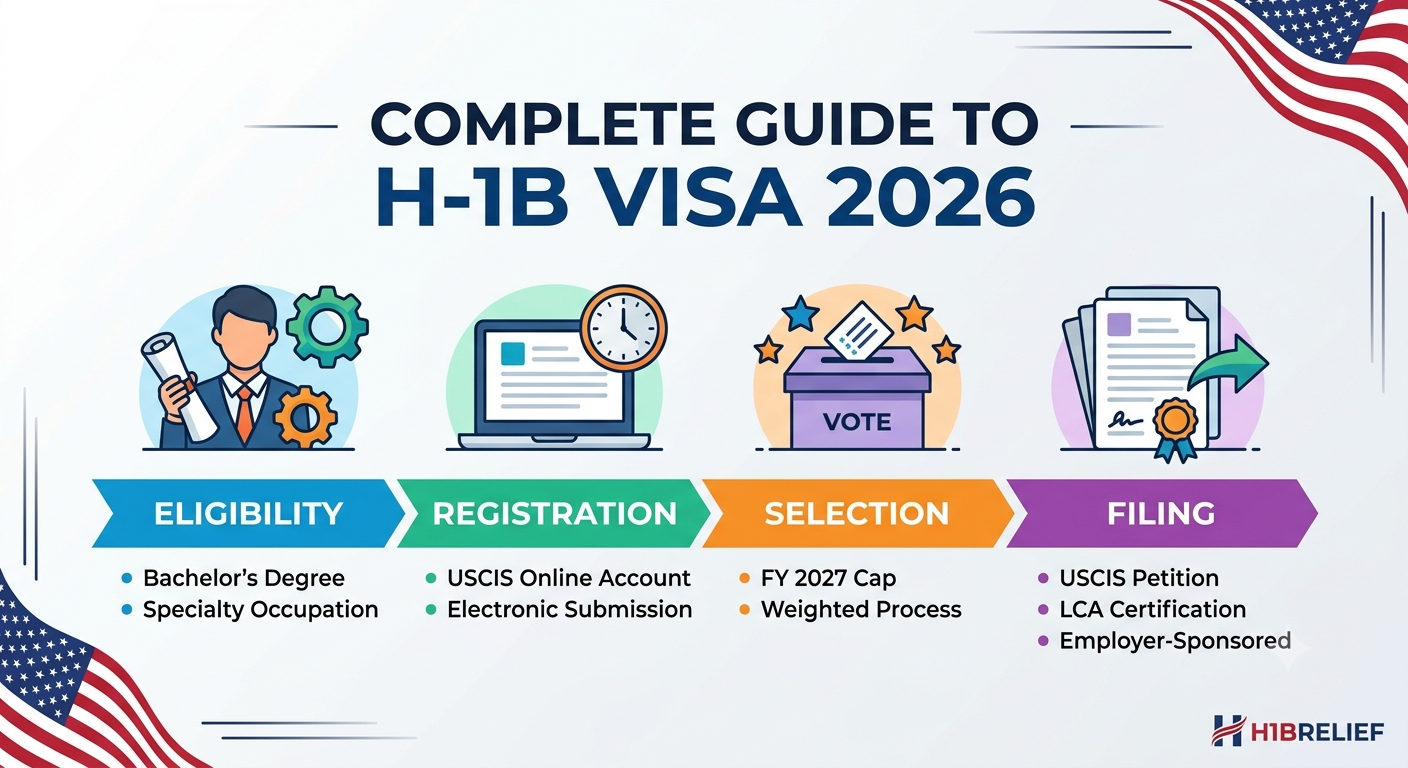
The H-1B process can generally be understood as a series of stages:
Employer identifies qualifying position
↓
Candidate and employer review eligibility
↓
Electronic H-1B registration
↓
USCIS selection process, when applicable
↓
Employer files H-1B petition
↓
USCIS adjudication
↓
Visa processing or status-related steps, depending on the applicant
The exact process can differ depending on whether the worker is already in the United States, whether the petition is cap-subject, and the circumstances of the employer and beneficiary.
H-1B Electronic Registration
USCIS uses an electronic registration process for the H-1B cap.
For FY 2027, USCIS announced that the initial registration period opened on March 4, 2026, and closed on March 19, 2026.
The registration process is important because employers generally must complete the required registration process before filing a cap-subject H-1B petition for a selected beneficiary.
USCIS also states that the registration tool and bulk-upload template were updated for the FY 2027 registration season.
Applicants should therefore avoid relying on instructions from older H-1B seasons without checking the current USCIS requirements.
H-1B Selection Process in 2026
The selection process is particularly important for cap-subject H-1B cases.
USCIS states that beginning with FY 2027, it implemented a weighted selection process that affects how H-1B visas are allocated.
This means applicants and employers should pay close attention to the rules applicable to the specific fiscal year rather than assuming that the process is identical to previous years.
USCIS announced on March 31, 2026, that the FY 2027 H-1B initial registration selection process had been completed and that selected petitioners could begin filing cap-subject petitions starting April 1, 2026.
Who Can Qualify for an H-1B Visa?
H-1B eligibility depends on both the position and the beneficiary.
The job generally needs to qualify as a specialty occupation, while the prospective worker must meet the applicable educational or experience requirements.
Potential evidence can include:
- Bachelor’s degree
- Advanced degree
- Equivalent qualifications where permitted
- Academic transcripts
- Professional credentials
- Relevant work experience
- Job description
- Employer documentation
- Evidence establishing the specialty occupation
Eligibility should be evaluated based on the specific facts of the case.
H-1B Employer Requirements
The employer plays a central role in the H-1B process.
An H-1B worker generally cannot simply apply independently for an employer-sponsored position without the required employer petition.
Employers may need to provide documentation relating to:
- The company
- The offered position
- Job duties
- Work location
- Compensation
- Employment relationship
- Specialty occupation requirements
- The beneficiary’s qualifications
The petition must satisfy applicable USCIS requirements.
H-1B Visa for Technology Professionals
Technology remains an important area for H-1B employment.
Potential technology-related positions include:
- Software Engineer
- Software Developer
- Mobile App Developer
- Cloud Engineer
- Data Engineer
- Data Scientist
- AI Engineer
- Machine Learning Engineer
- Cybersecurity Specialist
- DevOps Engineer
- Systems Analyst
However, a job title alone does not establish H-1B eligibility.
The employer and applicant need to consider the actual job duties, educational requirements, and applicable immigration standards.
H-1B Documents Checklist
Applicants and employers should prepare documentation carefully.
Depending on the case, documentation may include:
Applicant Documents
- Passport
- Resume or CV
- Degree certificate
- Academic transcripts
- Educational evaluation, where applicable
- Experience letters
- Professional credentials
- Previous immigration documents, if applicable
Employer Documents
- Company information
- Job offer
- Detailed job description
- Work location information
- Compensation information
- Organizational information
- Supporting business documentation
Immigration Documents
Depending on the case, additional immigration documentation may be required.
The exact documentation varies according to the applicant’s circumstances and petition type.
H-1B Salary and Labor Condition Requirements
H-1B employment involves requirements concerning wages and working conditions.
Employers should carefully evaluate the applicable wage requirements and Department of Labor obligations before proceeding with an H-1B filing.
Salary should therefore not be treated simply as a number placed into an immigration petition.
The employer needs to understand the applicable rules for the position, location, occupation, and employment circumstances.
H-1B Visa vs. H-1B Status
It is important to distinguish between an H-1B visa and H-1B status.
A visa is generally used for seeking admission to the United States.
Status refers to the individual’s authorized immigration classification while inside the United States.
This distinction becomes especially important for people already living and working in the United States.
For example, an applicant may have an H-1B petition approved through a change-of-status process rather than immediately obtaining a visa stamp at a U.S. consulate.
The appropriate process depends on the individual’s circumstances.
H-1B Change of Employer
H-1B workers may have circumstances in which they move from one employer to another.
The new employer generally needs to follow applicable H-1B petition requirements.
Workers considering an employer change should carefully review:
- Current immigration status
- Current H-1B petition
- New employer
- New job duties
- Work location
- Filing requirements
- Start date
- Portability rules, when applicable
Immigration counsel can help determine the appropriate filing strategy for a particular case.
H-1B Extension
An H-1B worker may need to extend their authorized stay when the current period approaches expiration.
The employer generally needs to file the appropriate petition and supporting documentation.
Before an extension, employers and employees should review:
- Current I-94
- Current approval notice
- Passport validity
- Employment information
- Job location
- Compensation
- Previous H-1B history
Planning ahead can help avoid unnecessary immigration complications.
H-1B and Green Card Process
H-1B status is temporary, while employment-based permanent residence is a separate immigration process.
An H-1B worker may potentially pursue an employment-based green card depending on their circumstances, employer sponsorship, category, and eligibility.
The process can involve stages such as:
PERM Labor Certification
↓
I-140 Immigrant Petition
↓
Priority Date
↓
Adjustment of Status or Consular Processing
The exact process varies by employment-based category and the applicant’s circumstances.
Because visa availability can depend on category and country of chargeability, applicants should review the current Visa Bulletin and USCIS guidance.
H-1B for International Students
International students in the United States may explore H-1B sponsorship after completing eligible education and maintaining appropriate immigration status.
Students may commonly transition through employment authorization options such as OPT before potentially moving into another employment-based status.
The timeline depends on the student’s degree, field, employment, immigration status, and employer.
Students should therefore begin planning well before their current authorization expires.
Common H-1B Mistakes
1. Waiting Until the Last Minute
H-1B cases involve multiple parties and documents.
Employers and candidates should plan early.
2. Using Outdated Information
Immigration procedures can change between fiscal years.
Always check current USCIS guidance.
3. Incomplete Documentation
Missing or inconsistent information can create unnecessary problems.
4. Incorrect Job Description
The job description should accurately reflect the actual position.
5. Ignoring Work Location
Work location can be relevant to immigration and labor requirements.
6. Assuming Selection Means Approval
H-1B registration selection does not itself mean that USCIS has approved the underlying H-1B petition.
The employer still needs to complete the required petition process.
What Changed for the FY 2027 H-1B Process?
The FY 2027 process includes important procedural changes.
USCIS announced that a weighted selection process would apply beginning with FY 2027.
USCIS also updated the electronic registration system and related registration materials for the FY 2027 season.
These changes make it particularly important for applicants and employers to use current USCIS information instead of relying exclusively on older articles, social media posts, or previous H-1B experiences.
How H1BRelief Can Help
At H1BRelief, we help individuals and employers understand the H-1B process and organize the information required for immigration planning.
Our resources can cover areas such as:
- H-1B visa information
- H-1B registration guidance
- H-1B eligibility
- H-1B documentation
- H-1B employer sponsorship
- H-1B extensions
- H-1B transfers
- H-1B change of status
- Employment-based immigration information
- Green card process information
Every immigration case is different.
The appropriate process depends on the applicant’s immigration history, education, employment, employer, location, and other case-specific factors.
H-1B 2026 FAQ
Is the H-1B process the same every year?
No. USCIS can change procedures and requirements. Applicants should check the rules applicable to the relevant fiscal year.
When did FY 2027 H-1B registration open?
USCIS announced that FY 2027 registration opened on March 4, 2026, and closed on March 19, 2026.
Does H-1B registration selection guarantee approval?
No. Selection allows the applicable petitioner to proceed with the H-1B petition process; USCIS must still adjudicate the petition.
Can technology workers apply for H-1B?
Technology occupations can qualify when the specific position and beneficiary satisfy the applicable specialty-occupation and eligibility requirements.
Can H-1B workers change employers?
There are circumstances in which an H-1B worker can change employers through the applicable petition process. The specific requirements depend on the individual’s situation.
Can H-1B workers eventually obtain a green card?
An H-1B worker may potentially pursue employment-based permanent residence if they and their employer meet the requirements of an applicable immigrant category.
Final Thoughts
The H-1B visa process in 2026 requires careful planning because immigration procedures, registration rules, and eligibility requirements can change.
For employers and foreign professionals, the key steps are understanding the applicable H-1B category, reviewing eligibility, preparing accurate documentation, completing the registration process when required, and following current USCIS filing procedures.
For FY 2027, USCIS has introduced a weighted selection process and updated the electronic registration system, making it particularly important to rely on current official information.
Before making immigration decisions, applicants should verify the latest information through USCIS and consider obtaining advice from a qualified immigration attorney for case-specific questions.
Need help understanding your H-1B options?
Explore H1BRelief’s H-1B resources to understand eligibility, registration, documentation, employer sponsorship, and the broader U.S. employment immigration process.
Comments