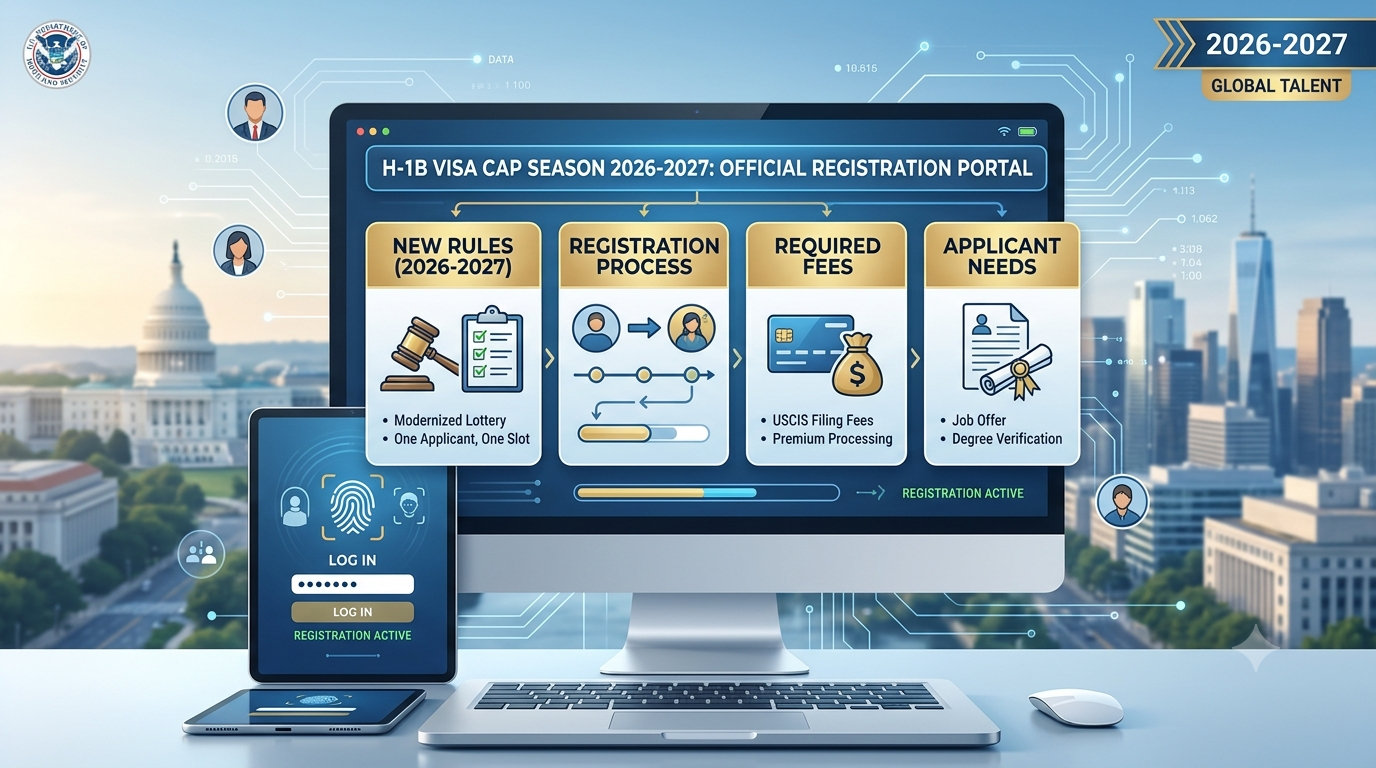
The H-1B visa remains one of the primary U.S. immigration pathways for foreign professionals seeking to work in specialty occupations. However, the H-1B process has undergone significant changes, making it increasingly important for applicants, employers, and immigration professionals to understand the latest requirements.
For the FY 2027 H-1B cap season, USCIS introduced a weighted selection process that generally gives greater selection weight to higher-paid and higher-skilled positions while retaining eligibility across wage levels. The rule became effective February 27, 2026. (LTNR)
At the same time, recent federal policy changes have introduced additional considerations for certain new H-1B petitions.
What Is an H-1B Visa?
The H-1B visa allows U.S. employers to temporarily employ foreign workers in specialty occupations that generally require specialized knowledge and a qualifying bachelor’s degree or equivalent.
Common H-1B occupations include:
- Software engineering
- Information technology
- Data science
- Artificial intelligence
- Engineering
- Healthcare
- Finance
- Architecture
- Scientific research
- Business and technology consulting
The employer generally plays a central role in the H-1B petition process because the H-1B is employment-based.
Major H-1B Changes for 2026–2027
Applicants and employers should pay particular attention to several recent developments.
1. Weighted H-1B Selection
One of the biggest changes is the introduction of a weighted selection process for the FY 2027 H-1B cap season.
Instead of treating every registration identically, the new system generally provides greater selection weight to registrations associated with higher wage levels, while maintaining opportunities for workers at different wage levels. (LTNR)
This means employers should carefully review the offered position, occupation, work location, wage level, and supporting documentation before completing the registration.
2. H-1B Registration Fee
USCIS currently lists the H-1B electronic registration fee at $215 per registration for the applicable registration process.
Employers should always verify the applicable USCIS fee immediately before submitting a registration because immigration fees and procedures can change.
3. Additional $100,000 Payment Requirement
A major policy development concerns certain new H-1B petitions.
Federal policy introduced a $100,000 payment requirement for certain H-1B petitions filed after September 21, 2025, subject to the applicable rules and exceptions. USCIS guidance and the relevant presidential proclamation should be reviewed before filing.
The White House subsequently extended the underlying restriction through September 21, 2027. (The White House)
Because the applicability of this payment can depend on the specific petition and circumstances, applicants and employers should not assume that every H-1B case is subject to the same payment requirement.
How the H-1B Registration Process Works
The H-1B process typically begins with the employer rather than the foreign worker independently filing for the visa.
Step 1: Employer Identifies the Position
The U.S. employer determines whether the position qualifies as a specialty occupation and identifies the appropriate occupational classification and work location.
Step 2: Employer Creates an H-1B Registration
During the designated registration period, the employer submits the required information electronically through the USCIS system.
The registration includes information about the prospective H-1B worker and the sponsoring employer.
Step 3: USCIS Conducts Selection
If USCIS receives more eligible registrations than available H-1B numbers, USCIS conducts its selection process.
For FY 2027, the selection process uses the new weighted methodology. (GovDelivery)
Step 4: Selected Employers File the Petition
Selection does not automatically mean that an applicant has received an H-1B visa.
A selected employer must generally proceed with the H-1B petition during the applicable filing period and provide the required supporting documentation.
Step 5: USCIS Reviews the Petition
USCIS reviews the petition, including factors such as:
- Employer information
- Offered position
- Specialty occupation requirements
- Beneficiary qualifications
- Wage information
- Supporting documentation
- Applicable fees
- Immigration history
Step 6: Visa Processing or Change of Status
Depending on the applicant’s circumstances, the case may involve a change of status inside the United States or consular processing outside the United States.
H-1B Eligibility Requirements
An H-1B applicant generally needs to satisfy requirements related to both the offered position and the worker’s qualifications.
A typical case may require:
A qualifying specialty occupation
The position should require specialized knowledge and normally a qualifying degree or equivalent.
Appropriate educational background
The beneficiary generally needs a bachelor’s degree or equivalent qualification related to the specialty occupation.
Employer sponsorship
The H-1B petition is generally submitted by the U.S. employer on behalf of the prospective worker.
Required immigration documentation
Depending on the case, documents may include:
- Passport
- Degree certificates
- Academic transcripts
- Resume
- Employment letters
- Previous immigration documents
- Current visa/status documents
- Job offer information
- Employer documentation
What Does the New Weighted Selection Mean for Applicants?
The FY 2027 weighted selection system changes how H-1B registrations are selected.
According to the final DHS rule, the system generally favors registrations associated with higher-paid and higher-skilled workers while retaining opportunities for registrations at all wage levels. (LTNR)
For employers, this makes accurate wage-level and position information particularly important.
Applicants should also understand that selection is not the same as approval. A registration being selected does not eliminate the need for a complete and approvable H-1B petition.
H-1B Employer Compliance Is More Important Than Ever
Employers should maintain accurate records throughout the H-1B process.
Important areas include:
- Job duties
- Work location
- Offered salary
- Occupational classification
- Employee qualifications
- Labor Condition Application requirements
- Petition documentation
- Immigration status
- Required filing fees
Inconsistent information between the registration, LCA, petition, employment documentation, and actual job can create unnecessary immigration complications.
Common H-1B Mistakes to Avoid
Incorrect Job Information
The job description should accurately reflect the position the employee will perform.
Inconsistent Salary Information
Salary and wage information should be carefully reviewed before filing.
Incomplete Documentation
Missing academic, employment, or immigration documents can delay case preparation.
Assuming Selection Means Approval
H-1B registration selection is only one stage of the process.
Ignoring New Policy Changes
H-1B regulations and presidential policies can change quickly. Employers should verify current USCIS requirements before submitting a petition.
Waiting Until the Last Minute
Employers and applicants should begin preparing documents well before important filing deadlines.
H-1B Visa Processing: What Applicants Should Expect
The overall timeline can vary significantly depending on the specific case.
A typical process can involve:
Employer preparation → Registration → Selection → Petition filing → USCIS adjudication → Approval → Visa processing or status change
Additional processing may be required depending on whether the applicant is inside or outside the United States.
Applicants should therefore avoid relying on a single standard processing timeline for every H-1B case.
How H1BRelief Can Help
H-1B immigration cases can involve complex documentation, changing government policies, employer requirements, and strict filing procedures.
H1BRelief can provide informational resources covering areas such as:
- H-1B registration
- H-1B visa requirements
- H-1B lottery and selection
- H-1B petition preparation
- H-1B employer sponsorship
- H-1B extensions
- H-1B transfers
- H-1B status issues
- Immigration policy updates
- U.S. employment-based immigration
Because immigration policies can change, applicants should verify current requirements through official government sources and obtain professional immigration advice when appropriate.
Final Thoughts
The 2026–2027 H-1B landscape is significantly different from earlier H-1B seasons. The introduction of weighted selection for FY 2027, changes surrounding certain new H-1B petitions, and continuing policy developments mean that employers and applicants need to pay close attention to current requirements. (LTNR)
The most important step is to prepare accurate documentation, understand the current H-1B process, and verify USCIS requirements before taking action.
H1BRelief can serve as a resource for applicants and employers looking for clear information about H-1B visas, U.S. immigration procedures, and employment-based immigration updates.
SEO Details
Primary Keyword: H-1B visa 2026
Secondary Keywords:
- H-1B visa 2027
- H-1B registration 2026
- H-1B lottery 2026
- H-1B requirements
- H-1B visa process
- H-1B registration process
- H-1B fees 2026
- H-1B sponsorship
- H-1B petition
- H-1B immigration
Suggested SEO Title:
H-1B Visa 2026–2027: New Rules, Registration, Fees & Process
Suggested Meta Description:
Learn about the H-1B visa 2026–2027 process, new weighted selection rules, registration, fees, eligibility, petition requirements, and important policy updates.
Suggested URL Slug:/h1b-visa-2026-2027-rules-registration-process/
Comments