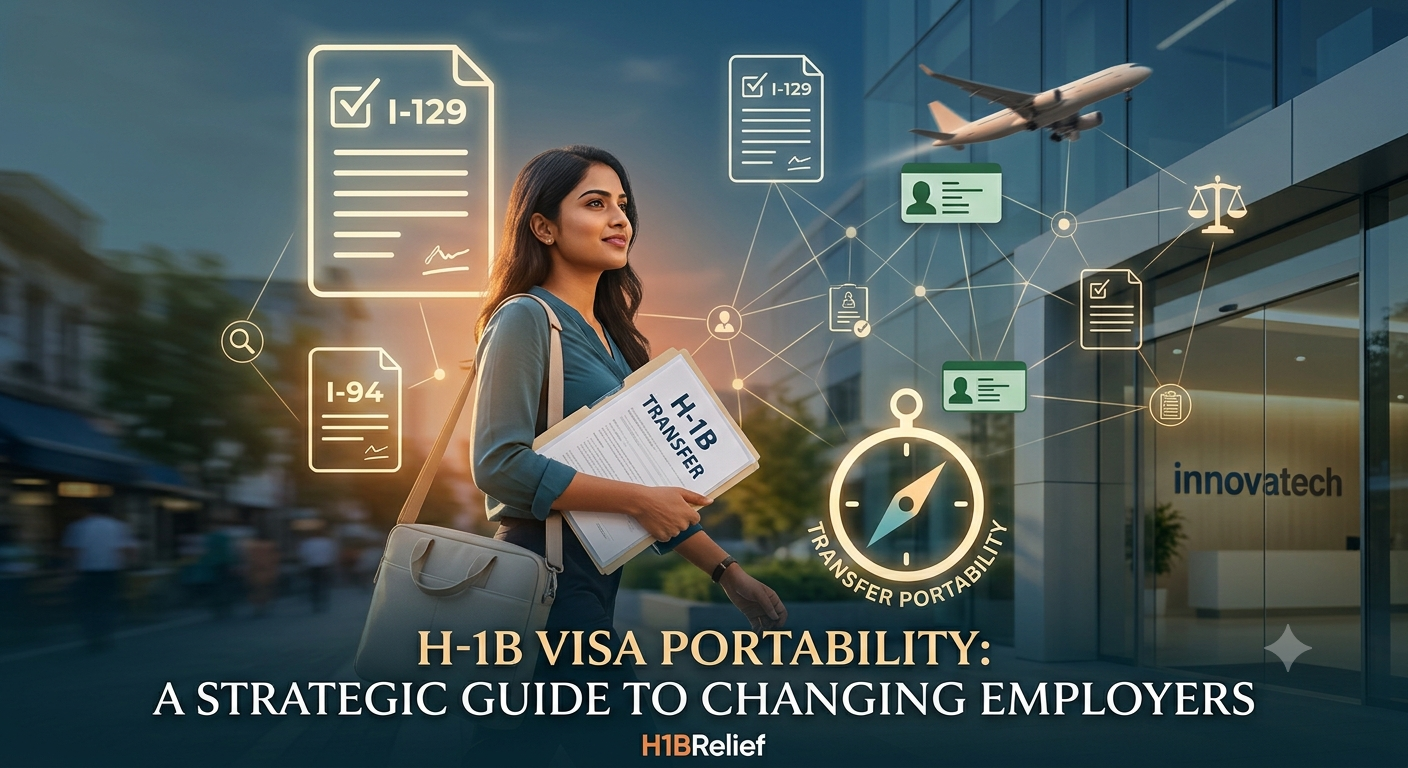
Changing jobs is a major career decision for any professional. For an H-1B worker, however, switching employers involves an additional layer of immigration considerations.
The good news is that U.S. immigration law provides an H-1B portability process that may allow eligible H-1B workers to begin working for a new employer after the new employer properly files an H-1B petition, without necessarily waiting for the petition to be approved.
But there are important requirements to understand before making a move.
This guide explains the key considerations H-1B professionals should know when planning an employer change.
Important: This article is for general informational purposes and is not legal advice. Individual immigration situations can be different, so consult a qualified immigration attorney for advice about your specific case.
What Is H-1B Portability?
H-1B portability is a provision that can allow certain H-1B workers to move to a new employer after the prospective employer files a qualifying H-1B petition.
USCIS explains that eligible H-1B workers may begin employment with the new employer upon the filing of a nonfrivolous H-1B petition, subject to the applicable requirements.
This can be particularly important for professionals who receive a better job opportunity but don’t want to remain with their current employer while waiting for the entire immigration process to finish.
When Can an H-1B Worker Change Employers?
An H-1B worker generally needs to make sure that the new employer files the appropriate petition before the worker’s existing authorized stay expires.
USCIS guidance identifies several conditions associated with H-1B portability, including lawful admission, timely filing of a qualifying petition, and compliance with employment authorization requirements.
Because the details can depend on the worker’s individual immigration history, it is important to review the situation carefully before resigning from an existing job.
Does the New Employer Need to File a New H-1B Petition?
Yes.
Changing employers generally requires the new employer to file an H-1B petition on the worker’s behalf.
The employer must follow the applicable filing requirements, including the required Labor Condition Application and Form I-129 process.
The portability provision does not mean that an H-1B worker can simply start working for any company without an immigration filing.
The new employer’s petition and the worker’s circumstances both matter.
Can You Start Working Before USCIS Approves the Petition?
For eligible H-1B portability cases, the answer can be yes.
USCIS states that qualifying H-1B workers may accept new employment upon the filing of a qualifying petition rather than waiting for USCIS approval.
However, this is one of the areas where individual circumstances matter.
Before starting the new position, workers should make sure the portability requirements are satisfied and that the petition has been properly filed.
What Happens to Your Current H-1B Status?
Your immigration status and employment situation should be reviewed carefully when changing employers.
H-1B workers are generally granted an initial period of up to three years, with extensions typically limited to a total of six years, although certain exceptions can allow additional time.
The timing of an employer change can therefore be important.
For example, someone approaching the end of their authorized H-1B stay may have very different considerations from someone who has several years remaining.
What Documents Should You Keep?
H-1B professionals should maintain organized copies of their immigration and employment records.
Depending on the situation, useful documents can include:
- Passport
- H-1B visa
- Form I-94
- Previous Form I-797 approval notices
- Current H-1B petition
- Employment offer letter
- Employment verification documents
- Pay statements
- Labor Condition Application documentation
- Previous immigration filings
Keeping these records organized can make future immigration processes easier.
What If You Are Planning a Green Card?
An H-1B job change can become more complicated when an employment-based green card process is already underway.
For example, certain employment-based adjustment applicants may qualify for job portability after an I-485 application has been pending for at least 180 days, provided the new job is in the same or a similar occupational classification.
This is different from H-1B portability.
Therefore, someone who has an H-1B transfer and an employment-based green card process should look at both situations together.
Common H-1B Job Change Mistakes
1. Resigning Too Early
One of the biggest mistakes is leaving the current job before understanding the timing and filing status of the new H-1B petition.
2. Assuming Every Job Change Is the Same
Different immigration histories can produce different outcomes.
A transfer involving a current H-1B worker is not necessarily the same as moving from another immigration status into H-1B status.
3. Ignoring the I-94 Expiration Date
The I-94 is an important document for determining the authorized period of stay.
Workers should understand their current status and expiration dates rather than relying only on the expiration date printed on an H-1B visa.
4. Starting Work Without Confirming Eligibility
Even though H-1B portability can allow qualifying workers to begin employment after filing, the requirements need to be satisfied.
5. Forgetting About the Long-Term Immigration Strategy
A job change may affect more than the immediate H-1B transfer.
If a worker is pursuing permanent residence, the timing and nature of the new employment can matter.
What About Multiple H-1B Employers?
H-1B workers can, in certain circumstances, work for more than one H-1B employer.
USCIS guidance explains that each employer generally needs to file the appropriate Labor Condition Application and H-1B petition.
This can be relevant for professionals who are considering multiple employment arrangements.
However, because the rules are technical, professional legal guidance is recommended before entering such an arrangement.
How Can H1BRelief Help?
Immigration processes can involve complicated paperwork, deadlines, documentation, and changing requirements.
H1BRelief can provide educational resources and help people better understand the H-1B landscape, including topics such as:
- H-1B transfers
- H-1B extensions
- Employer changes
- Immigration documentation
- H-1B-related processes
- Employment-based immigration
- Green card pathways
- Immigration updates
The goal is to make complex immigration information easier to understand and navigate.
A Better Way to Approach an H-1B Job Change
Before making a job change, consider following a structured process:
Step 1: Review your current immigration status.
Step 2: Check your I-94 and relevant expiration dates.
Step 3: Discuss the new position with the prospective employer.
Step 4: Confirm that the employer understands the H-1B filing requirements.
Step 5: Make sure the required petition is properly filed.
Step 6: Confirm whether H-1B portability applies to your circumstances.
Step 7: Keep copies of all immigration and employment documents.
Step 8: If you have a pending green card or another immigration matter, review how the job change could affect it.
Final Thoughts
An H-1B job change doesn’t have to be overwhelming, but it should never be treated like a simple employment switch.
Timing, documentation, immigration status, employer filings, and long-term immigration plans can all matter.
Understanding the process before making a move can help H-1B professionals make more informed decisions and avoid unnecessary complications.
For the latest requirements and official immigration information, always verify the rules with USCIS and consider speaking with a qualified immigration attorney about your individual circumstances.
H1BRelief is committed to making complex H-1B and employment-based immigration information easier to understand—so professionals can make better-informed decisions about their future.
Comments